


Shopify + Flavorcloud
The Complete Shopify Cross-Border Playbook
30% of your Shopify store visitors are already coming from international markets. The brands converting them didn’t find a bigger audience. They removed the friction that was already costing them one: surprise duties at the door, prices that read as foreign, and no signal on where to go deep. This guide covers all of it: whether you’re switching providers or starting fresh, going live with FlavorCloud in under 30 minutes, and turning international into a real, compounding growth channel.
the opportunity
The demand is already there. Most brands aren’t capturing it.
Cross-border ecommerce is growing faster than domestic in most markets globally, and the infrastructure that supports it has finally caught up. Landed cost calculation, carrier network access, customs documentation: the operational complexity that used to require dedicated logistics teams and multi-year carrier contracts is now automated. That’s a relatively recent shift. What it means practically is that the barrier between wanting to sell internationally and actually doing it has dropped significantly. The merchants on our platform who are growing international revenue aren’t operating differently in any exotic way. They moved when the conditions made it viable, got the fundamentals right, and built from there. The conditions are viable now, and getting the fundamentals right is what this guide is about.
Where most brands sit vs. where the winners are
The market is large and growing fast
Global B2C cross-border ecommerce is projected to reach nearly $8 trillion by 2030, up from around $785 billion in 2021. Cross-border is now growing faster than domestic ecommerce in many regions, and 30% of the visitors already hitting your Shopify store are coming from international markets. The demand is on your site today.
Sources: Statista · Shopify, 2025
The setup barrier is gone
From what we see across the merchants on our platform: the operational complexity that used to make international feel risky (carrier contracts, customs brokers, manual duty calculation) is now fully automated. A Shopify brand can go live with real-time Delivered Duty Paid (DDP) rates, automated documentation, and branded tracking in under 30 minutes. The barrier that kept most brands waiting no longer exists.
Trade agreements are handing US brands a cost edge
The United States-Mexico-Canada Agreement (USMCA) gives US-origin goods preferential or zero duty rates into Mexico and Canada, two of the largest and most accessible cross-border markets for US Shopify brands. Most merchants eligible for those rates aren’t capturing them consistently because they haven’t set up the product data (Harmonized System (HS) codes, country of origin) to qualify. Getting that right is a structural cost advantage that’s hard for competitors to replicate quickly.
Source: USTR / trade.gov
How the world pays has shifted
Digital wallets (Apple Pay, Google Pay, PayPal, and dozens of regional equivalents) now drive 66% of global online spending. That means the majority of international shoppers expect to tap through checkout without re-entering payment details. A store that shows prices in an unfamiliar currency and doesn’t support the payment method the shopper uses loses the sale at the moment of highest intent, regardless of how good the product is.
Source: Shopify, 2025
Checkout friction is costing brands more than they realize
49% of international shoppers refuse delivery when surprise duties show up at the door. 75% rethink buying from that retailer again. These aren’t edge cases. They’re the direct, measurable cost of shipping without DDP. The brands winning cross-border have eliminated this category of loss entirely: one transparent total at checkout, nothing unexpected on delivery.
Source: Avalara, 2024
Compliance used to be a reason to wait. Now it’s a moat.
De minimis thresholds, Harmonized System (HS) code classification, country-specific labeling requirements. These were real operational barriers in 2020. Today FlavorCloud handles classification, documentation, and duty calculation automatically on every order. From what we see on our platform, the brands that invested in getting compliance right early are now significantly harder to compete with. The complexity that kept others out became their moat.
What keeps most brands stuck at 10–20%
The gap between brands doing 10–20% international and those doing 40–60% is rarely about product or demand. It's about three specific friction points, and all three are solvable.
Checkout friction
Duties unknown until delivery. Customers abandon when they see unexpected fees, or worse, receive a package and refuse it. DDP removes this entirely: one transparent total at checkout, nothing at the door.
Pricing that doesn't travel
FX-derived prices swing daily, rarely land on compelling local price points, and signal to international shoppers that you haven't committed to their market. Deliberate, market- specific pricing converts. Exchange rate math doesn't.
No market signal
Shipping everywhere, optimizing nowhere. Without data on which markets are converting, which verticals have demand, and which price points work by country, international stays a guessing game. Commerce Intelligence replaces the guessing with signal.
The Commerce Intelligence advantage. For most brands, international sits at 10–20% of revenue. For the brands using Commerce Intelligence (real-time market signals, conversion analytics by country and vertical, pricing optimization on autopilot), it reaches 40–60% and becomes their most defensible, compounding source of growth. This guide covers both halves: how to go live fast, and how to grow it into something real.
switch providers
Switch providers without losing a single order.
Switching providers doesn’t require a cutover weekend, a maintenance window, or a leap of faith. Most brands who come to FlavorCloud aren’t starting from zero. They’re running DDU (Delivered Duty Unpaid), a competing DDP provider, or a patchwork of carrier-direct rates that’s suppressing conversion without anyone noticing why. A good migration proves itself country by country, running alongside what’s already live, and only replaces the old setup once it’s earned that spot. Here’s how we sequence it.
Audit your current international rates before touching anything: note which zones, carriers, and terms of trade (DDP or DDU) are active today.
Install FlavorCloud alongside your existing provider. The same 5-step setup below applies whether you’re starting fresh or migrating. Nothing about your current setup breaks during this step; the app installs independently of your live rates.
Test in one zone first. Using Shopify rate setup, add FlavorCloud as a rate option in a single low-volume country and confirm landed cost, tracking, and customs clearance all behave as expected on real orders.
Cut over zone by zone once you’re confident: expand from one country to your full international footprint at a pace that matches your comfort level rather than a fixed deadline. Apply the same configuration best practices in each new zone as you would on a first install.
Retire the legacy rates last. Only remove your old provider’s rates and any legacy duty/tax calculations after FlavorCloud is validated across every zone you’re migrating.
The one mistake to avoid. Never leave two providers calculating duties on the same zone at the same time. That’s how customers get charged twice. Migrate zone by zone, and fully remove the old rate before FlavorCloud goes live in that country.
Still deciding whether to switch, or comparing providers before you commit? Our breakdown of 10 questions to ask when choosing a DDP shipping provider is a useful gut-check either way, including a few questions worth asking your current provider.
get set up
Live in 30 minutes. Shipping to 200+ countries by end of day.
Five steps. No carrier contracts, no customs broker, no dedicated logistics team. FlavorCloud handles the rates, the documentation, and the tracking. You handle the products.
Zero to live
First order ready
From day one
or Grow w/ add-on
step 1
Install FlavorCloud App
Plan requirement. FlavorCloud uses Shopify’s third-party calculated rates, included on Shopify Advanced and Plus and available on the Grow plan with annual billing or a monthly add-on. They are not available on Basic or Starter.
Log in to your Shopify admin.
Click Apps in the left sidebar → Visit the Shopify App Store.
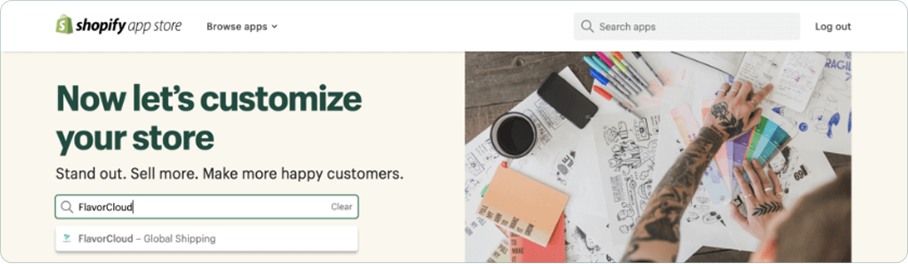
Search “FlavorCloud” → click Add App → Install App.
ShipBob merchants: Use the ShipBob FlavorCloud Self-Onboarding guide instead of these steps.
step 2
Create account
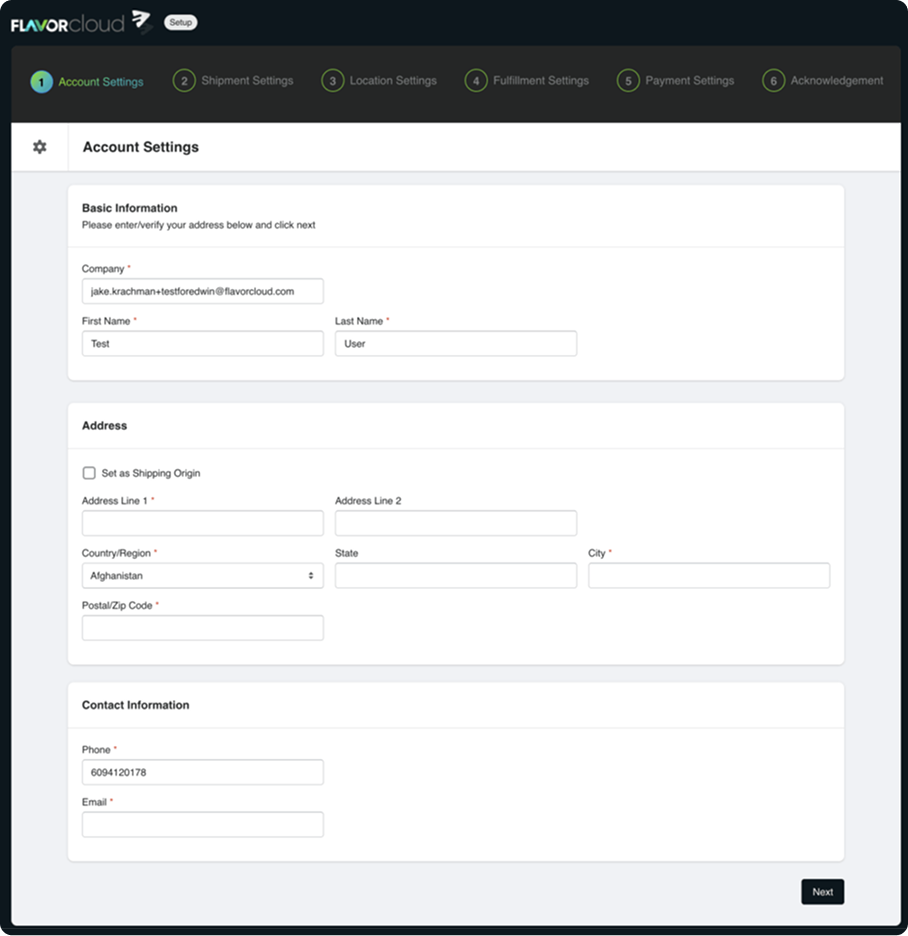
After installing, the FlavorCloud setup wizard launches automatically. Existing accounts go straight to login.
Complete the setup wizard. It covers every required field.
Check your inbox for a confirmation email and click the verify link to activate.
step 3
Configure settings
Work through each section in your FlavorCloud app before touching Shopify again. This covers account information, payments, shipping preferences, checkout settings, warehouses, conversion optimization rules, and branded tracking. Terms of trade (DDP is the default and recommended) is the most important single decision in this step.
information
- Review your account information
- Enter your Tax ID
Payments
- Enter payment instrument information
- Set up invoicing
Shipping
- Choose Auto or Manual fulfillment
- Select service levels: Standard and/or Express
- Select terms of trade: DDU (duties paid at destination customs) or DDP (duties paid at checkout). Default is DDP
- Review default package dimensions and weight for your average package size (without contents)
- Select FlavorCloud print settings
- Select insurance options for express orders
- Review the default country of origin (country of manufacture)
- Add any SKUs you want the FlavorCloud API to ignore
Checkout Settings
- Review and customize the shipping method layout (how options display at checkout)
Warehouses
- Review shipping origin address (if different from account address)
- Review ship-from location (typically your warehouse) or import from Shopify
Conversion Optimization
Set up shipping and landed cost rules (discounts and markups) to control how rates are presented at checkout.
Branded Tracking
- Review tracking page templates, two-column or three-column (FlavorCloud recommends three-column for mobile)
- Update colors and fonts if desired (not required)
- Upload logo (max 500×241px) and hero image at the same time (must change both together)
- Upload ad section image: 3-column max 367×654px · 2-column max 702×540px
Stop losing customers at their front door.
DDP is the default in FlavorCloud for a reason. Every brand that ships DDU is making a trade-off that costs them more in refused packages, chargebacks, and lost repeat customers than the operational simplicity is worth. When a customer completes checkout and receives a surprise duty bill at their door, your brand takes the hit. DDP removes it entirely. We recommend every Shopify merchant shipping internationally start with DDP and never look back.
| DDP Recommended | DDU | |
|---|---|---|
| When duties are collected | At checkout | At delivery |
| Customer experience | One price, no surprises | Surprise bill at door |
| Package refusal rate | Eliminated | 49% refuse delivery |
| Retailer retention | Higher repeat purchase | 75% rethink buying again |
| Customs clearance | Faster, pre-declared | Variable, customer-dependent |
| Merchant customs liability | Covered by FlavorCloud | Customer bears the risk |
| Conversion impact | Higher: transparent landed cost | Lower: cost uncertainty at checkout |
Refusal and retention stats: Avalara, 2024 · What is Guaranteed DDP? →
step 4
Shopify rate setup
Connect FlavorCloud as your rate provider. Every international order should go through FlavorCloud and only FlavorCloud, so every shopper sees accurate, all-in landed cost pricing.
In Shopify: Settings → Shipping and delivery.
Open your Shipping Profile → Manage Rates.
Create a new international zone: add every country you want to sell to.
Click Add Rate → select FlavorCloud from the provider dropdown.
Check “Future Services”: new carrier options surface automatically, no manual updates needed.
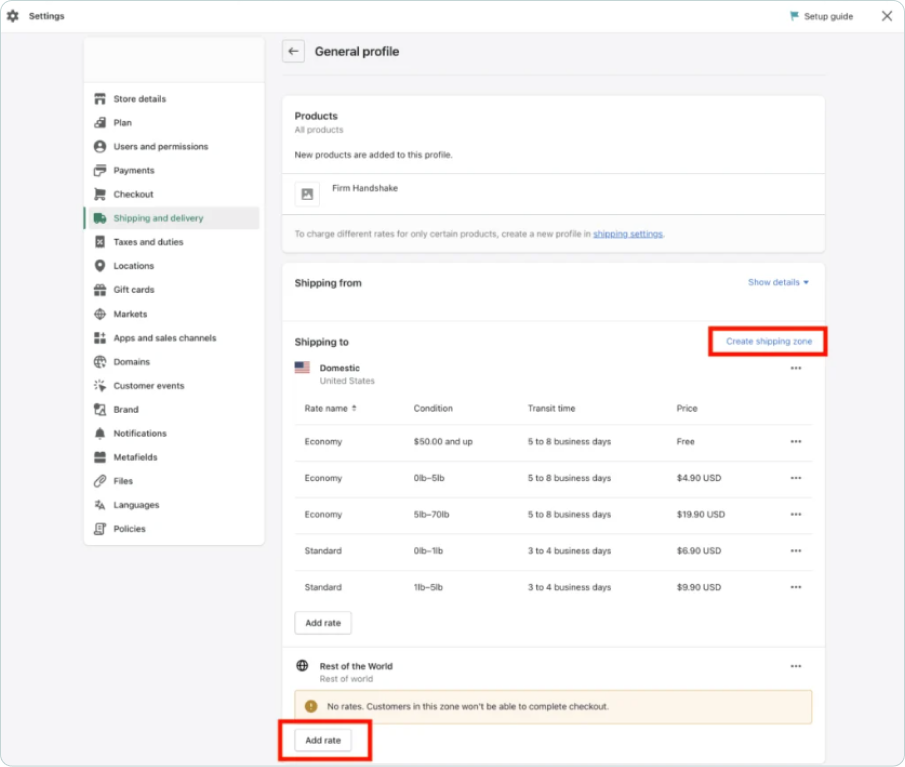
FlavorCloud must be the only rate in your international zone. Remove all other carriers. If FlavorCloud appears in your Domestic zone, remove it (international only).
step 5
Product data
Every product needs three fields. Missing any one on a single line item prevents duties and taxes from calculating for the entire cart. Audit your catalog before you go live. This is the unglamorous step most brands skip and then wonder why international checkout isn’t working.
Weight
Exact product weight used to calculate shipping rates. Pick grams or ounces and apply consistently across your entire catalog.
RequiredHS Code
Harmonized System code that classifies your product for customs: it sets the duty rate applied and qualifies you for preferential rates under trade agreements.
RequiredCountry of Origin
Where the product was manufactured. Determines preferential duty eligibility under agreements like USMCA, US-Korea FTA, and others.
RequiredYou’re live. FlavorCloud now calculates real-time DDP rates at checkout for every international order: duties, taxes, and shipping in one transparent total. From here, the work shifts from setup to growth.
Confirm your products can ship before you promote them.
Two questions decide whether a product can go live in a market: is it a dangerous good, and is its category restricted on import. Screen your catalog for both before you promote, so a shipment does not stall at customs after the order is already placed.
Dangerous goods (DG)
Flammable, corrosive, or hazardous items move under strict rules. The most common in DTC are lithium-ion batteries, perfume, and nail polish, which are generally barred from passenger aircraft and need special packaging, labeling, and documentation. As of 2026, many lithium-ion batteries must ship by air at 30% state of charge or lower under International Air Transport Association (IATA) rules. Not sure if a SKU qualifies? Ask XB AI. FlavorCloud’s compliance agent can confirm DG classification for you directly.
Restricted categories
Some categories clear only with the right ingredients, a permit, or a local importer. The three DTC categories with the most import friction are vitamins and supplements, cosmetics and personal care, and food and beverage, where the specific ingredients and concentrations decide whether a product clears. XB AI can flag which of your SKUs fall into these categories and what’s needed to clear them, market by market.
The categories with the most demand are the ones most likely to be held. Health and Wellness is the fastest-growing vertical on the FlavorCloud network at +39%, with Beauty and Cosmetics close behind, and both sit squarely in the restricted-import categories above. Flag any SKU with batteries, liquids, aerosols, or regulated ingredients, and confirm destination rules per market before you go live. Ask XB AI rather than researching each rule yourself. FlavorCloud’s compliance automation and 300+ carrier network route dangerous goods on services that accept them, but the product review has to happen first.
your first week live
Catch the one mistake before it costs you 200 orders.
Going live isn’t the finish line. It’s the first real test. The fastest way to catch a setup issue is to watch a handful of real international orders move end-to-end before you stop paying attention. Here’s what to check in the first few days.
Place a real test order to an international address
Confirm branded tracking page renders correctly
Check FlavorCloud dashboard for order status
Raise it through your FlavorCloud account. Don’t wait or guess
Place a test order to an international address you control and walk the full checkout: confirm the FlavorCloud rate appears, the landed cost total looks right, and no duplicate duty line shows up.
Open the order’s branded tracking page and check the logo, colors, and ad section render as expected. This is often the last thing tested and the first thing a customer sees.
Check your FlavorCloud dashboard daily for the first week. Look for orders stuck in a pending or exception state. These usually trace back to a missing product field.
If something looks off, a rate that seems too high, a shipment that stalls, a tracking page that won’t load, reach out through your FlavorCloud account rather than guessing. Most issues trace back to one of the settings in Configuration best practices below.
Give it a real week before judging conversion. International shoppers research more before buying. Don’t pull the plug on a new market after two days of quiet. Evaluate performance across a full order cycle rather than a single afternoon.
configuration best practices
Get it right once. Profit on every order after.
You're live, but these six settings make the difference between international working well and creating problems no one catches. None are required to install FlavorCloud, but all six directly affect whether orders clear customs, whether customers abandon at checkout, and whether the rates FlavorCloud returns are accurate. Most take under five minutes each.
What to do
When adding your FlavorCloud rate in Shopify, check "Future Services." FlavorCloud will automatically surface new carriers, delivery speeds, and cost-optimized routes as they become available, no manual updates required.
Why it matters
- Customers always see the most current shipping options without you touching a setting
- Stays compliant with carrier and regulatory changes automatically
- Removes a recurring maintenance task from your team
What to do
Turn off all duty and tax calculations for international orders in Shopify and any third-party tax apps. FlavorCloud calculates landed cost automatically. A second calculation creates double-charging, which is one of the top drivers of international checkout abandonment.
Why it matters
- Overcharging at checkout is the leading cause of international cart abandonment
- Eliminates discrepancies between checkout price and what customs actually charges
- Ensures a clean, predictable DDP experience on every order
What to do
Install an address validator and require Latin characters (A–Z) only in shipping address fields. Many international carriers cannot process Cyrillic, Arabic, Chinese, or Korean characters. The label prints, the shipment moves, and then it stalls at customs or last-mile delivery.
Why it matters
- Latin characters are mandatory for most global carrier processing systems
- Non-Latin addresses cause delivery failures silently, no error at checkout, just a stalled shipment
- Reduces return-to-sender costs and customs clearance holds significantly
What to do
Set the phone number field to required in your Shopify checkout. Some carriers mandate a contact number to arrange customs clearance or resolve delivery exceptions. An order without a phone number is an order that cannot be reached when something goes wrong.
Why it matters
- Reduces failed deliveries caused by missing contact information
- Enables proactive tracking notifications directly from the carrier to your customer
- Gives customs and last-mile carriers a route to resolution before a shipment stalls
What to do
Delete all non-FlavorCloud rates from your international shipping zone: flat rates, legacy carrier rates, everything. FlavorCloud must be the sole provider for international orders. If customers can select a rate that doesn't include landed costs, some will. And then your support queue fills with customs fee complaints.
Why it matters
- Prevents customers from selecting rates that don't include duties, the root cause of surprise delivery fees
- Surprise customs fees at delivery drive chargebacks, disputes, and lost repeat customers
- A single clean rate option keeps checkout clean and improves international conversion
What to do
Confirm your shipping origin address is accurate in both Shopify and FlavorCloud, and that the two are in sync. The origin address is the foundation for every landed cost calculation, transit time estimate, and carrier routing decision FlavorCloud makes on your behalf.
Why it matters
- Wrong origin = wrong rates. Landed cost accuracy starts here
- Prevents customs documentation errors that cause clearance delays
- Correct routing reduces shipping costs and improves delivery time accuracy
common setup mistakes
Turn a broken checkout into a two-minute fix.
Almost every issue merchants run into after go-live traces back to one of the six settings above. Here's what each symptom usually means, and where to look first.
Likely cause
The destination country isn't included in the shipping zone where FlavorCloud is added as a rate, or Future Services wasn't checked when the rate was created.
Fix
- Confirm the country is listed in the correct Shopify shipping zone
- Re-open the FlavorCloud rate in Shopify and check Future Services
- Make sure FlavorCloud is the only provider active in that zone. A conflicting rate can suppress it
Likely cause
Shopify's own duty and tax calculation, or a third-party tax app, is still active alongside FlavorCloud's landed cost calculation on international orders.
Fix
- Turn off duty and tax calculation in Shopify settings for international zones
- Disable any third-party tax app (e.g. Avalara) for the same zones
- Re-run a test order to confirm only one landed cost total appears at checkout
Likely cause
One or more line items on the order is missing weight, HS code, or country of origin, or the shipping address contains non-Latin characters a carrier's system can't process.
Fix
- Audit the SKUs on the affected order for missing required fields
- Confirm the address validator is active and enforcing Latin characters (A–Z)
- Check that a phone number was collected. Carriers often need it to resolve a customs hold
Likely cause
Default package weight and dimensions in FlavorCloud don't reflect your actual average package, or terms of trade (DDP vs. DDU) were set differently than intended for that country.
Fix
- Review default package dimensions and weight in FlavorCloud shipping settings
- Confirm terms of trade match what you intended per country
- Use Conversion Optimization rules if you need country-specific markups or discounts rather than editing defaults
Likely cause
Logo and hero image must be uploaded together in Branded Tracking settings. Uploading only one leaves the page in a default state.
Fix
- Re-upload logo (max 500×241px) and hero image at the same time
- Confirm the ad section image matches your chosen layout, 3-column or 2-column dimensions
growth strategies
Turn international into your biggest growth channel.
We see thousands of Shopify stores ship internationally. The ones growing international revenue aren't doing anything exotic. They've made a different set of choices, about friction, pricing, data, and market commitment, that the brands stuck at 10–20% haven't made yet. Here's what we see consistently.
-
Stop losing orders to surprise fees at delivery
Surprise fees at delivery are the top driver of abandonment in every market. When a customer sees a clean, all-in price at checkout, with duties and taxes already included, they complete the purchase. When they don't know what's coming, they abandon, or worse, they receive the package and refuse it. For brands serious about international, DDP is the baseline. The brands winning globally set it once, never revisit it, and let it do its job on every order.
-
Bad product data blocks the entire cart
Weight, HS code, country of origin (COO): three fields that most brands treat as a one-time setup task and then forget. The brands that maintain them correctly across their entire catalog have a structural advantage. Accurate HS codes qualify you for preferential duty rates under trade agreements. Correct COO lets FlavorCloud route shipments to minimize landed cost. A complete catalog means no orders held at customs, no duty bills pushed to the customer's door, and no international carts that fail to calculate at checkout.
Most brands fix this once and never revisit it. The ones that grow fastest build a process to get it right on every new SKU, including everything added after launch.
-
Price by market to convert more
A price that is simply your USD list price run through an FX feed swings daily, rarely lands on a compelling price point in the local market, and signals to the shopper that you haven't committed to their market. The brands winning set deliberate price points at the SKU level for each market, localized so each price reads as native, adjusted for the margin inputs that move it (tariffs, fuel surcharges, seasonality), and updated when those inputs change. FlavorCloud's Pricing Intelligence runs this on autopilot, with Localized Market Pricing (LMP) setting the price at the SKU level, and reports against the two numbers that tell you whether a market is working: conversion rate and margin per order.
-
Make checkout feel local, and win the sale
Prices in local currency, payment methods the market actually uses, addresses that work with local carrier systems. For serious international brands, these are table stakes. Shoppers compare. A checkout that reads as foreign loses to local alternatives even when the product is better. Currency localization, required phone collection, and Latin-character address validation are the three checkout settings that deliver the biggest conversion lift per hour of configuration time.
-
Tune strategy by market, and growth compounds
The brands that try to be everywhere at once end up optimized for nowhere. The ones growing international revenue fastest use data to identify which markets are converting for their specific product, where pricing friction is suppressing conversion, and which peaks to pre-position for by country. They go deep in two or three markets before expanding, and they use Commerce Intelligence to make that call with data rather than instinct.
What works in Canada often differs from what works in the UK or Mexico: pricing, merchandising, and peak calendar all shift by market. The brands winning treat each market as its own channel, tuned accordingly rather than run off one global playbook.
Go deeper by country. The International Expansion Hub covers market intelligence, consumer behavior, peak calendars, and compliance requirements by country, the operating framework for tuning your strategy market by market instead of guessing.
Recommended settings to compound growth
What to do
In Shopify Markets, enable all available countries. FlavorCloud's carrier network handles the logistics. You don't need to manage per-country complexity. Remove FlavorCloud from domestic regions while you're there to avoid checkout confusion.
Why it matters
- Opens revenue from high-demand markets you may not have prioritized yet
- Intelligent routing finds cost-effective carrier options to any destination automatically
- No additional logistics setup. The network does the work
What to do
Enable localized currency in Shopify so international shoppers see prices in their own currency. Ensure your checkout supports the payment methods your target markets actually use. Digital wallets now drive 66% of global online spending, with regional leaders like Mercado Pago, Alipay, and iDEAL dominating in their respective markets. Pair both with FlavorCloud's DDP for a fully transparent, all-in purchase price.
Why it matters
- 66% of global online spending now goes through digital wallets. A checkout that doesn't support them loses the majority of international shoppers at payment
- Showing prices in an unfamiliar currency signals you haven't committed to the market, and shoppers notice
- Currency localization combined with DDP eliminates every source of checkout surprise for international buyers
What to do
Use Shopify's country-level pricing tools alongside FlavorCloud's Pricing Intelligence to set deliberate price points by market, native price points shaped by how each country buys rather than pulled from a daily FX conversion. Use Commerce Intelligence to identify which categories are converting by market and which verticals are over-indexed in cross-border demand for your product type.
Why it matters
- Market-specific pricing converts significantly better than exchange-rate-derived pricing
- Vertical demand signals tell you where to invest marketing and inventory before competitors do
- The International Expansion Hub gives your team country-level context to make these calls with market data rather than instinct
international returns
Returns are a retention lever.
International returns are the half of cross-border most brands never plan for, and it shows up directly in repeat purchase. Cross-border return rates run higher than domestic, with apparel and footwear the highest-return categories. US online returns are estimated at 19.3% of sales in 2025 (per NRF and Happy Returns), and fashion runs well above that. A returns policy is not a back-office detail. Roughly 82% of shoppers say free returns are a major consideration when they buy (per NRF and Happy Returns), so an unclear or missing international returns policy suppresses the sale before the cart loads.
If you sell into the EU, returns are not fully yours to define. The EU Consumer Rights Directive gives shoppers a 14-day right of withdrawal on distance purchases, no reason required, with a full refund of the item and original standard shipping. Fail to disclose that right and the window extends by twelve months. A new EU withdrawal button becomes mandatory on June 19, 2026, which puts the burden on the seller to have it in place.
Duty and tax recovery is the piece most brands miss. On a returned order, VAT collected through schemes like IOSS is generally recoverable, while import duty already paid is often absorbed unless you file for a refund. Build the recovery step into your reverse flow so returns do not erase the margin on the original sale.
Returns are part of the repeat-purchase equation. FlavorCloud supports returns across the same 200+ country network you ship on, so an international return is a recoverable event with a path back to duty and tax recovery, rather than a write-off. Set a market-specific returns policy, disclose it before checkout, and treat the return experience as a driver of the loyalty that makes international compound.
language & localization
Currency gets you the checkout. Language gets you the browse.
Currency and payment localization get shoppers to checkout. Language gets them to consider the product in the first place. 76% of shoppers prefer to buy products with information in their own language, and 40% will not buy from a site in another language at all, per CSA Research. That is a ceiling on your addressable market in any non-English country, set before pricing or shipping enters the picture.
The gap is structural, and it shows up in the data. In FlavorCloud network data, Asia converts at 10% and LATAM at 6%, well below ANZ at 24% and North America at 20%. Part of that gap traces to how much of the buying experience still reads as foreign to a local shopper. Localize in this order, since the earlier items carry the most purchase weight:
-
Product titles, descriptions, and size or spec detail. These carry the most purchase weight and are where hesitation starts.
-
Checkout and shipping copy, so the final step reads as native rather than translated.
-
Returns policy, sizing guidance, and support pages, which build the trust that drives repeat purchase.
-
Legal and consumer-rights notices required in-market, including the EU withdrawal disclosure covered above.
Make the whole path read as native. Pair Shopify’s translation and Markets tools with FlavorCloud’s localized landed cost so everything, from product page to delivered total, reads and prices in the shopper’s own terms. Language, plus local currency, plus guaranteed DDP removes every signal that tells an international shopper you have not committed to their market.
delivery speed & promise
Show a specific delivery date.
International shoppers will wait for a package. What they will not do is guess. Showing a specific delivery date at checkout, rather than a vague day range, is one of the highest-impact settings on the page: Narvar’s 2025 survey found 73% of shoppers say a visible delivery date influences their purchase and 40% will not buy without one. Yet Baymard research shows 41% of checkouts still display only a shipping speed, which leaves a wide gap for any brand that shows an actual date.
Precision beats raw speed. McKinsey found delivery reliability now outranks speed, which fell from the top delivery priority in 2022 to fifth by 2024. A slower date a shopper can trust converts better than a faster one they cannot. The risk is not hypothetical: when Q1 2026 conflict widened Middle East transit windows, FlavorCloud network Gross Merchandise Value (GMV) into affected Gulf markets dropped between 30% and 87% in a single quarter. Delivery certainty is a conversion input and a resilience input at once.
-
Show a date or tight date range at checkout, rather than “3 to 5 business days.”
-
Set the estimate against real lane performance rather than a carrier’s best-case service level.
-
Widen the estimate automatically during peak or known disruption, so the promise stays credible.
-
Offer an express tier where the market’s order value supports it. Asia carries one of the network’s highest regional AOVs at $139.
Hit the date without overspending. FlavorCloud’s carrier-agnostic network routes across 300+ carriers to meet a delivery date without defaulting to rush service, and branded tracking keeps the shopper informed after checkout, which is where cross-border repeat purchase is won or lost.
fraud & chargebacks
Manage cross-border fraud without turning away real demand.
International orders carry a different risk profile than domestic, and the answer is calibration rather than avoidance. Cross-border transactions are disproportionately exposed to card fraud: the European Central Bank and the EBA found about 71% of card fraud value came from cross-border transactions, even though they are a minority of volume. The cost compounds past the lost item, at about $4.61 in total losses for every $1 of fraud (per LexisNexis) once you add chargeback fees, shipping, and support.
The bigger trap is overcorrecting. False declines cost retailers an estimated $443 billion a year, roughly nine times the cost of actual fraud (per Riskified), and blunt rules that block a whole country turn legitimate international demand away at the door. First-party (friendly) fraud is now the leading fraud type globally (per LexisNexis Risk Solutions), which is exactly the dispute type that clear pricing and delivery prevent.
-
Enter a new market with tighter billing and shipping match rules, then loosen as you learn its fraud pattern rather than blocking it outright.
-
Use velocity and value rules to moderate higher-risk orders instead of declining all of them.
-
Keep clean records of the delivered landed total, since a transparent all-in price is the best defense against “I was charged more than expected” disputes.
Guaranteed DDP is a dispute control as much as a conversion lever. When the shopper sees one all-in total at checkout and no surprise bill at the door, you remove the single most common trigger for cross-border chargebacks and refused deliveries. FlavorCloud’s data ties guaranteed landed costs to lower chargebacks and returns.
grow international demand
Grow the traffic behind the checkout.
The rest of this playbook assumes international traffic is already arriving. Growing that traffic is the other half of the equation, and it is changing fast. AI is becoming the discovery layer: Shopify’s Q1 2026 earnings reported AI-driven traffic up 8x and orders from AI search up nearly 13x year over year, with structured-catalog traffic converting at twice the rate of scraped sources. Clean classification, landed cost, and market pricing data are now a discovery advantage on top of a compliance one.
Localized organic search
Language-specific search demand grows faster than English in many verticals, and localized pages with proper hreflang capture qualified traffic at lower cost than paid.
Social and creator commerce
The global social commerce market reached about $821 billion in 2025 and is on pace to pass $1 trillion by 2028, and it is where a large share of cross-border discovery now happens.
Market selection as a growth act
Market choice remains one of the least data-driven decisions cross-border merchants make. Spending demand-gen budget in a market where your product has no pull is the most common way brands stall.
Gauging where the demand actually is? FlavorCloud Market Intelligence is a free report that analyzes your store’s international traffic, demand, and conversion by country, then sizes each market’s upside in dollars and maps every gap to a specific growth lever. It runs on data already in your Shopify and FlavorCloud integration, so you invest ad and inventory budget where real demand exists rather than where you assume it does.
commerce intelligence
The data layer that turns international into compounding revenue.
Without Commerce Intelligence
With Commerce Intelligence
market intelligence
Identifies where the international growth opportunity actually is for your specific brand, before you spend on inventory or marketing to go there.
- White space analysis: which markets are under-served for your category
- Per-market conversion signals and demand trends by vertical
- Growth recommendations engine tuned to your actual performance
- Checkout abandonment insights by country and cost driver
pricing intelligence
Sets and maintains deliberate, market-native price points at the SKU level, automatically updated as the inputs that drive margin change.
More international orders
higher checkout conversion
More shoppers reach checkout
Among merchants using Pricing Intelligence, vs. those without it
- Localized Market Pricing (LMP): SKU-level pricing per market
- Market Sensitive Pricing: dynamically adjusts to tariffs, surcharges, and seasonality
- Conversion optimization on autopilot: reports against conversion rate and margin per order
- Removes FX-derived pricing and replaces it with native market price points
Commerce Intelligence combines Market Intelligence and Pricing Intelligence in one layer, fine-tuned to each merchant’s actual performance, market behavior, and FlavorCloud network data. If you’ve already activated Localized Market Pricing (LMP), you’re partway there. Enabling Commerce Intelligence opens the full market signal and optimization layer on top. No additional Shopify integration required.
where to start
Five markets for US brands to start with.
You do not have to choose between the biggest markets and the fastest-growing ones. For a US brand going live, the strongest opening portfolio pairs anchor markets that are large, mostly English-first, and operationally simple with breakout markets showing outsized growth. The one strategy to avoid is a single-market plan: Switzerland (+68%) and France (+47%) grew far faster than Canada, the highest-volume lane, so anchoring in Canada while testing a breakout market captures both.
Thresholds below are for US-origin goods and are the value under which duty or tax is generally waived. Confirm per shipment, since rules change and depend on how goods are declared.
| Market | Why start here | Duty / tax threshold (US-origin) | FlavorCloud signal |
|---|---|---|---|
| Canada | Proximity, USMCA preferential rates, English and French, and the largest lane on the network. | Duty-free to CA$150, sales tax applies above CA$40 for courier shipments from the US. | +13% YoY, 36% repeat rate |
| United Kingdom | Largest single European market, English, and a mature ecommerce audience. | Import VAT (20%) at checkout for orders at or under £135; low-value duty relief is being removed from October 2028. | -19% YoY, a pricing and landed-cost opportunity rather than lost demand |
| Australia | English, high conversion, and a straightforward threshold. | Duty and border GST free to A$1,000; register and charge 10% GST at checkout once over A$75k/yr in Australian sales. | ANZ is the highest-converting region at 24% |
| Switzerland | High purchasing power, low price sensitivity, and strong premium US-brand demand. | Import VAT (8.1%) once tax due reaches CHF 5 (roughly CHF 62 of goods); register for Swiss VAT above CHF 100k/yr. | Fastest-growing market at +68% Q1 2026, 43% repeat rate |
| Singapore | English, high income, business-friendly free port, and an emerging APAC cross-border hub. | Most goods enter duty-free (free port); 9% GST collected at checkout once over S$1M global plus S$100k Singapore sales. | +43% Q1 2026, emerging APAC hub |
Validate before you commit. Use Market Intelligence to confirm which of these markets actually has demand for your specific catalog, and what the upside is worth in dollars, before you invest. Mexico (USMCA, +53% growth) and Germany (+58% lane growth) are strong sixth and seventh picks once the first five are running.
peak season prep
Your international peak season countdown.
International checkout friction intensifies under peak-season pressure: more first-time shoppers, less patience for a surprise duty bill, and a support team that’s already stretched. The brands who protect international revenue during peak start preparing weeks out rather than the week of. Volume can spike fast once peak hits, and the stakes only rise from there.
60 days out: confirm the fundamentals
FlavorCloud auto-classifies HS codes and calculates DDP in real time, but only for products with complete data behind them. Confirm every SKU has weight, country of origin, and a valid HS code, and that DDP is active in every zone you’re promoting.
30 days out: stress-test checkout
Place test orders into your highest-volume international markets and confirm currency localization, payment methods, and address validation all hold up. Digital wallets drive 66% of global online spending. Confirm your checkout supports the ones your peak markets actually use.
Source: Shopify, 2025
2 weeks out: check your signal
Use Commerce Intelligence to see which markets and verticals are converting ahead of peak. This is your last real window to shift inventory or marketing spend toward the countries already showing demand.
Peak week: watch, don’t set and forget
Check the FlavorCloud dashboard daily for exceptions. A stalled shipment caught on day one is a quick fix. The same issue discovered after 200 orders is a support crisis.
DDP matters most exactly when volume is highest. Surprise duties at delivery are the top driver of refused packages and abandoned repeat purchases. The cost of getting this wrong compounds fastest during your highest-traffic weeks of the year. Apparel & Fashion is proof of how fast that traffic can build: the vertical saw a +178% surge from Q1 to peak in 2025 on the FlavorCloud network, the widest swing of any tracked vertical.
Source: State of Cross-Border Commerce 2026
johnnie-o growth story
The market Johnnie-O didn’t know they needed.

From Our Merchants
Premium Lifestyle Apparel · Shopify
Higher AOV in UAE vs. other intl markets
Johnnie-O had strong international markets on their radar. Asia and Scotland were expected wins given the golf culture. What FlavorCloud’s Commerce Intelligence surfaced was the one they almost missed: the UAE, which emerged as a standout market with an average order value (AOV) that outpaced every other international destination.
“Discovering such strong demand in the UAE was a great surprise. It’s opened up new opportunities for us, and we’re excited to keep building on this momentum.”
Kelsey Finn, VP of Ecommerce, Johnnie-O
YoY growth in global GMV
YoY growth in shipment volume
Higher AOV in UAE vs. other intl markets
International is an asset. We help you build it.
FlavorCloud is the AI-native Cross-Border Commerce OS. We calculate the full landed cost (duties, taxes, and all customs-related fees) at checkout and deliver with guaranteed DDP: accurate pricing, no surprise bills, faster clearance, higher conversion. Turn international business into international revenue with FlavorCloud Commerce Intelligence.
measuring roi
What to expect: measuring international ROI.
Cross-border ROI shows up in three places, and each has a number you can hold a program to. The headline is the revenue gap: most brands sit at about 16% of revenue from international, while brands running FlavorCloud’s Commerce Intelligence reach 40 to 60%. Closing that gap is the return. The levers below are how it compounds.
Conversion
Removing checkout friction moves the first number. FlavorCloud’s Localized Market Pricing pilot lifted conversion about 6 points on average, with individual gains from +3 to +14. Merchants using Pricing Intelligence saw 40.1% more international orders and 14.1% higher checkout conversion versus those without it.
Source: FlavorCloud data
Order value
AOV grew across every segment in Q1 2026. Higher-value orders carry better unit economics, because fixed shipping and landed cost spread across a larger basket.
Repeat purchase
This is where cross-border compounds. The network averaged a 35% repeat buyer rate against a 20 to 30% ecommerce benchmark, and the Enterprise segment crossed 50%, driven by predictable DDP delivery rather than loyalty programs.
International shoppers research more before buying, so judge a new market over a full order cycle rather than a first week. Track four numbers per market: checkout conversion, AOV, repeat buyer rate, and margin per order. The proof point is Johnnie-O, which grew global GMV +62% and shipment volume +109%, and found its highest-value market through Commerce Intelligence rather than instinct.
The return shows up as the move from a side channel at 16% of revenue to a compounding one at 40 to 60%, built on estimates becoming guarantees, guessing becoming signal, and a one-time setup becoming repeatable growth across markets.
Questions Shopify merchants actually ask
Alongside it. Shopify Markets handles storefront localization: currency, domains, and market-level pricing. FlavorCloud plugs in as your international rate provider, calculating real-time DDP landed cost at checkout and handling customs, documentation, and carrier selection behind it. Most merchants run both together.
Advanced or Plus, or Grow with an add-on. FlavorCloud relies on Shopify’s third-party calculated rates, included on Advanced and Plus and available on the Grow plan via annual billing or a monthly add-on. They are not available on Basic or Starter.
Yes. DDU is available as a terms-of-trade setting. We recommend DDP for nearly every Shopify brand: it removes the surprise-duty-at-delivery problem that drives package refusals and lost repeat customers. See Configure settings for how to choose between them.
In most cases, yes. FlavorCloud is carrier-agnostic and integrates with your existing warehouse and fulfillment setup. ShipBob merchants should follow the ShipBob FlavorCloud Self-Onboarding guide instead of the standard install steps above.
Duties and taxes won’t calculate for the entire cart, well beyond the affected line item. This is the single most common cause of checkout and customs issues. Audit your catalog for weight, HS code, and country of origin before promoting internationally. See Common setup mistakes for the fix.
Yes. FlavorCloud installs alongside your current setup, so nothing about your existing rates breaks during migration. Test in one zone, confirm it’s working, then cut over country by country. Full walkthrough in Switching providers above.
No additional Shopify integration required. Commerce Intelligence layers on top of your existing FlavorCloud account and starts surfacing market and pricing signal from your order data once it’s enabled.
Around 30 minutes for the core 5-step setup, assuming your Shopify plan already supports third-party rates. Getting your product data fully audited (weight, HS code, country of origin across your catalog) is usually the longer task, and worth doing before you promote internationally rather than after.
The best DDP option for a Shopify store is a rate provider built to plug directly into Shopify’s own checkout rather than a bolt-on that requires a separate storefront or redirect. FlavorCloud installs as a native Shopify app, connects through Shopify’s third-party calculated rates (Advanced, Plus, or Grow plans), and returns real-time, guaranteed DDP pricing at checkout in under 30 minutes of setup.
What to look for
- Native Shopify integration: no separate checkout or redirect required
- Guaranteed DDP rather than DDP-labeled DDU: the provider carries the customs liability on your behalf
- A carrier-agnostic network (200+ countries) rather than a single-carrier relationship
- Growth tooling beyond shipping: market and pricing intelligence, well beyond a rate calculator
For a deeper comparison framework, see 10 questions to ask when choosing a DDP solution.
In the EU, yes. The Consumer Rights Directive gives shoppers a 14-day right of withdrawal on distance purchases, and failing to disclose it extends the window to a year. Other markets vary, but a clear returns policy lifts conversion everywhere. FlavorCloud supports returns across the same network you ship on, with a path back to duty and VAT recovery. See International returns.
Often yes, with conditions. Lithium batteries, perfume, and nail polish are dangerous goods with packaging and carrier rules, and supplements, cosmetics, and food frequently need ingredient documentation or a local importer to clear customs. Screen your catalog before you promote a market. See Ship-eligible products.
For US brands, Canada, the UK, and Australia make strong anchor markets (large, English-first, simple to operate), with Switzerland and Singapore as high-growth breakouts. Use Market Intelligence to confirm demand for your catalog before you commit. See Where to start.