FlavorCloud’s Conversion Optimization tools are designed to help you increase sales and revenue by strategically adjusting your shipping and landed cost rates. These rules allow you to offer targeted incentives—like free shipping, discounts, or cost offsets—that encourage customers to complete their purchases instead of abandoning their carts.
When used effectively, Conversion Optimization Rules can:
- Improve checkout conversion rates by removing cost barriers at the final stage of purchase.
- Increase average order value (AOV) by encouraging customers to meet certain thresholds for free shipping or duty discounts.
- Support targeted promotions by tailoring shipping and landed cost incentives for specific markets, products, or timeframes.
- Enhance competitiveness by aligning your international checkout experience with customer expectations in different countries.
Think of these rules as a way to fine-tune your pricing strategy at the most critical point of the customer journey the checkout so you’re not just covering costs, but actively using shipping and landed cost incentives to drive growth.
How can you set up Shipping Cost Rules?
To create a new Shipping Cost Rule, navigate to Conversion Optimization > Shipping Cost Rules. Then click the “Add Shipping Cost Rule.”
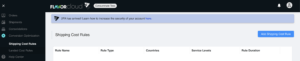
| Field | Description |
| Rule Name | Enter a descriptive name for the rule in this field. |
| Duration | With the duration option, you can set the length of time the rule is in effect. This allows you to run promotions or discounts for specific periods, such as during a holiday season or for a limited-time sale. You can also set no end for continuous conversion optimization. |
| Rule Type | Four rule types are available: Free shipping cost, flat amount, discount, and markup. These options allow you to choose the kind of discount or markup that will work best for your business and help you achieve your desired conversion goals. |
| Order Value | This option allows you to trigger the rule by order value. You can set the minimum or maximum order value that qualifies for the rule. For example, you can offer free shipping for orders over $50 or a 10% discount for orders over $100. |
| Service Levels | You can trigger the rule by the service level. You can apply the rule only to specific service levels, such as standard or express. |
| Locations | The location option lets you trigger the rule by the destination country. This allows you to offer different discounts or markups to customers in different countries. For example, you can provide free shipping to customers in Canada and Mexico but not to customers in the EU. |
| Products | The products options lets you trigger a rule based on the products in your FlavorCloud Products Page. |
| Display Free Shipping Deadline | Displays a shipping discount deadline message during the last 30 days of rule eligibility. |
How can you set up Landed Cost Rules?
To create a new Landed Cost Rule, navigate to Conversion Optimization > Landed Cost Rules. Then click the “Add Landed Cost Rule.”
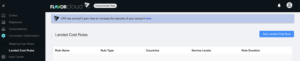
| Field | Description |
| Rule Name | Enter a descriptive name for the rule in this field. |
| Duration | With the duration option, you can set the length of time the rule is in effect. This allows you to run promotions or discounts for specific periods, such as during a holiday season or for a limited-time sale. |
| Rule Type | Four rule types are available: Free landed cost, flat amount, discount, and markup. These options allow you to choose the kind of discount or markup that will work best for your business and help you achieve your desired conversion goals. |
| Order Value | This option allows you to trigger the rule by order value. You can set the minimum or maximum order value that qualifies for the rule. For example, you can offer free landed cost for orders over $50 or a 10% discount for orders over $100. |
| Service Levels | You can trigger the rule by the service level. You can apply the rule only to specific service levels, such as standard or express. |
| Apply To | The “Apply To” field allows you to specify which parts of the landed cost the rule should apply to. You can apply the rule to Duties, Taxes, and/or Fees. This gives you greater flexibility in how you structure your pricing and promotions. For example, you can create a rule that applies a discount only to duties and taxes or a markup only to fees. The rule can be set to apply to any combination of the three components, giving you the ability to customize your pricing strategy to your specific needs. |
| Locations | The location option lets you trigger the rule by the destination country. This allows you to offer different discounts or markups to customers in different countries. For example, you can provide free landed cost to customers in Canada and Mexico but not to customers in the EU. |
| Offset Landed Cost Discounts | You can also offset landed cost discounts by rolling them into shipping costs. This helps you maintain pricing transparency while offering customers discounts on landed costs. |
Rule uniqueness: avoiding overlaps
When creating Conversion Optimization Rules, it’s important to ensure they do not overlap. Otherwise, the system won’t know which one to apply.
Overlapping example (not allowed):
- US → IE with order value between $20–$40 → Free Shipping
- US → IE with order value between $30–$50 → $10 Shipping
In this case, an order valued at $35 meets the criteria for both rules, and the system would not know which one to apply.
Because multiple products can be in a cart at once, product specific overlaps are also not allowed. For example:
- US → IE with Product A → Free Shipping
- US → IE with Product B → $10 Shipping
If both Product A and Product B are in the cart, the rules would conflict.
Allowed example (non-overlapping):
- US → IE with order value between $20–$40 and Product A → Free Shipping
- US → IE with order value between $41–$50 and Product B → $10 Shipping
Here, the order value restriction ensures that both rules cannot apply to the same order, avoiding conflicts.
Following these guidelines ensures your rules work as intended and deliver a smooth, predictable checkout experience for customers.