~$62B
Projected ecommerce market size in 2026, growing to $143B by 2031
Mordor Intelligence, 2026
Mexico's growth is not evenly distributed. A handful of categories are pulling the market, and several of them map directly
onto what US brands already sell well. The pattern below comes from the two events that concentrate the most online
demand in the country, Hot Sale and El Buen Fin, plus full-year category data. If your catalog sits in fashion, beauty,
electronics, or premium consumables, you are selling into the fastest-moving part of the market.

The single most-purchased category during Hot Sale 2025, bought by 28% of digital shoppers. Clothing and accessories also led full-year Small and Medium Enterprise (SME) sales at roughly 20% of online transactions. Sizing confidence and easy returns matter most here.
Fast Company México / AMVO, 2025
Bought by 20% of Hot Sale 2025 shoppers and 17% of SME transactions year-round. Beauty and personal care drove 77.9% of online beauty orders in 2025, one of the highest digital-penetration categories in the country.
Mordor Intelligence, 2026
Computers, phones, and tablets were bought by 18% of Hot Sale 2025 shoppers. Consumer electronics is projected to grow at roughly 19.45% a year through 2031, the fastest category CAGR in the market, and a natural fit for installment offers.
Mordor Intelligence, 2026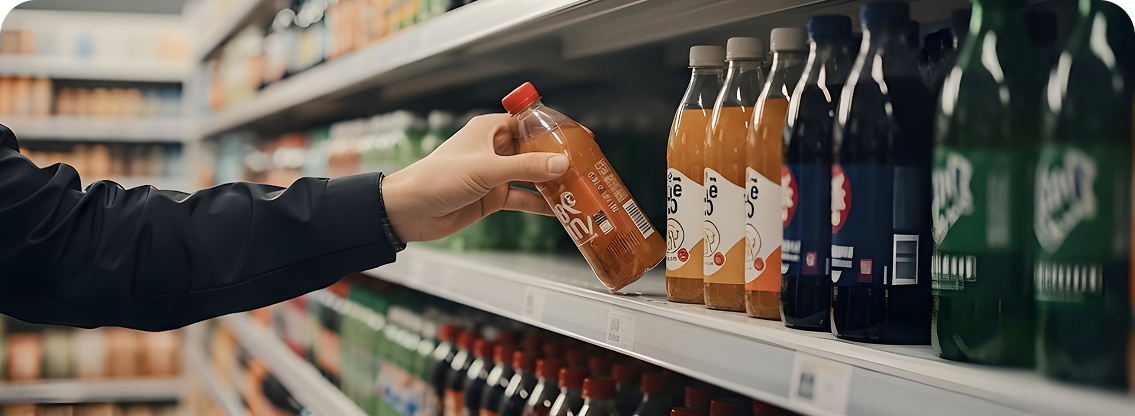
Food and beverage held the largest single share of online revenue in 2025 at 23.85%, supported by rapid digital grocery adoption. Premium and specialty consumables travel well cross-border when landed cost is handled cleanly.
Mordor Intelligence, 2026The bigger picture. For most brands, international sits at 10 to 20% of revenue. For the brands winning globally, it reaches 40 to 60%, and it becomes their most defensible, compounding source of growth. The gap is about risk rather than demand: compliance exposure, pricing that does not travel, and supply chains built for a single market. Mexico is where US brands can close that gap fastest, and this guide is how.
Compliance and guaranteed Delivered Duty Paid (DDP) get you across the border. That is the foundation, the
layer that de-risks international and makes it operational. Growth is the layer on top. FlavorCloud calls it
Commerce Intelligence, using your own funnel data alongside our cross-border network data to find the
opportunity, act on it, and compound it market by market. The plays below are that layer applied to Mexico.
They draw on what Mexican shoppers actually do, where they spend, how they pay, and what they expect, so
you can prioritize the few moves that move the number.
Mexican shoppers concentrate spending around a small set of national moments, and roughly 7 in 10 consumers deliberately time purchases to them (Elogia, 2025). You do not need a year-round blitz. You need to show up, in stock and with offers live, on these dates.
Late May
The country's largest online-first event. The 2025 edition hit MX$42.7B (US$2.5B), up 23.7%, across 19.2M orders with an average ticket of MX$1,100. Fashion, beauty, and electronics led.
AMVO via Mexico Business News, 2025Mid-Nov
Mexico's five-day national discount weekend. Total 2025 sales reached MX$219B (US$12B), with online up 31% to MX$45.9B, a record 21% of the event.
AMVO via Mexico Business News, 2025Jan 6
The Epiphany gifting day, projected at roughly MX$26.1B (US$1.6B) for 2026, up 8%. Demand concentrates in toys, electronics, clothing, footwear, and perfumes.
CONCANACO via Mexico Business News, 2026May 10
Mexico's biggest fixed-date gifting moment after the year-end season. The date never moves off May 10 regardless of weekday, so the demand spike is predictable years out.
NIQ México, 2025Nov-Dec
The longest spending window of the year. Mexico City alone projected an economic impact of about MX$114.9B for the 2025 season, a signal of how much demand stacks into the fourth quarter.
CANACO CDMX via Mexico Business News, 2026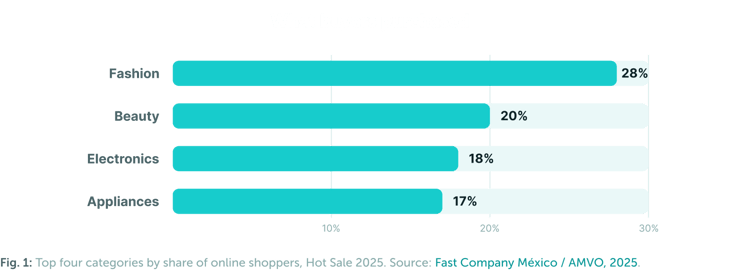
Speed in Mexico is less about being the fastest and more about clearing one bar: arriving when promised, intact, and inside the window shoppers expect. Most Mexican online shoppers expect delivery in under 5 days, and your proximity advantage, with express parcels clearing the border in 1-3 business days, sits comfortably inside that window. The cheaper win is to offer a choice of speeds and then hit the date you promised.
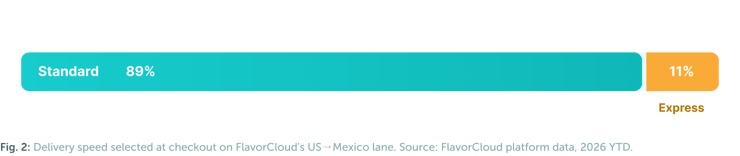
◎Standard carries nearly nine in ten orders, so price it as your default and treat Express as an upsell rather than the headline rate. Public data tells you what shoppers expect. Your own split tells you how to price and promote the option.
Checkout is where Mexico lanes most often leak revenue. Payment and checkout friction is the most-cited reason Mexican shoppers abandon a purchase, and three in four say they will not hand over banking details to a site they do not trust. A single all-inclusive price, with duties, IVA, DTA, and any Impuesto Especial sobre Producción y Servicios (IEPS) already calculated and collected, removes the doubt at the exact moment a shopper decides whether to proceed. Mexico assesses IVA on Cost, Insurance, and Freight (CIF) plus duty combined rather than on the product price alone, so a rough estimate at checkout becomes a surprise bill at the door.
A raw USD-to-MXN conversion shown at checkout reads as foreign and, worse, often costs the shopper more. When a buyer pays in a currency other than their own, dynamic currency conversion markups inflate the price, and shoppers notice. Transparent pricing in Mexican pesos is repeatedly flagged as a baseline requirement for selling cross-border into Mexico. Set deliberate peso price points instead of letting the exchange rate set them for you. It signals you belong in the market instead of passing through it.
Mexico is a mobile-first, Spanish-first market. Around 78% of ecommerce transactions happen on a phone, so a checkout that is not clean on mobile is a checkout that loses sales. Normas Oficiales Mexicanas (NOMs) already require Spanish on your product labels. The storefront, product detail, and checkout should match that, because a buyer comparing options will choose the experience that reads as built for them. Localization goes beyond translation: sizing guidance, trust signals, and merchandising tuned to each peak moment all matter.
of transactions happen on a phone.
Cards carry most of Mexico's ecommerce today, but that mix is partly a symptom: shoppers without a card, and there are many, simply cannot check out. Bank transfer and wallets each take about 20% of online payments, and cash-voucher methods like OXXO Pay convert the unbanked into buyers you would otherwise never see. The merchants who win offer a stack that matches how the country pays.
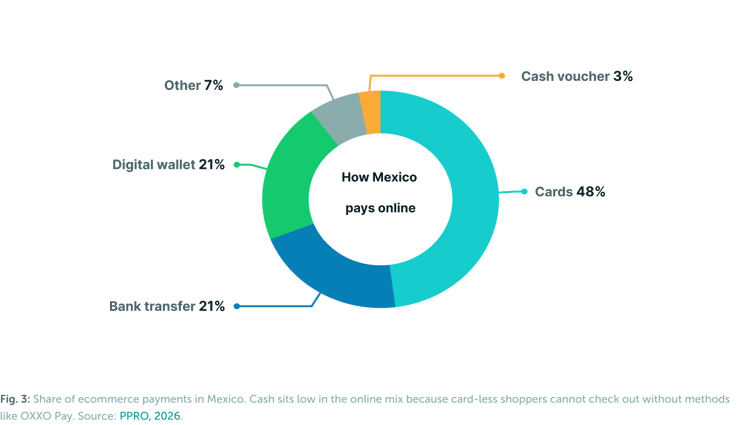
Cash still represents roughly 31% of Mexico's broader payments market even though it is a small slice of online checkout.
Mexican shoppers are price-sensitive and actively compare before buying, and they judge the peso figure in front of them. A price that is simply yesterday's USD list run through an FX feed will swing with the rate and rarely lands on the price points local buyers respond to. FlavorCloud Pricing Intelligence sets deliberate prices at the SKU level, localized so each price reads as native, and updates them as the inputs that drive margin move: tariffs, fuel surcharges, and seasonality around peaks like Hot Sale and Buen Fin. It runs on autopilot and reports against the two numbers that decide whether a market is working, conversion and margin.
Context: NIQ via Mexico Business News, 2025
Mexico has two separate de minimis tiers depending on whether your goods qualify under USMCA/T-MEC. Both thresholds are calculated on a CIF basis (Cost of goods + Insurance + Freight), rather than the product sale price alone.
| SHIPMENT TYPE | VAT (IVA) DE MINIMIS | DUTY DE MINIMIS | BASIS |
|---|---|---|---|
| Non-USMCA (all other origins) | $50 USD | $50 USD | CIF |
| USMCA qualified (express courier) | $50 USD | $117 USD | CIF, T-MEC certified |
CIF explained: Mexico calculates customs value on a CIF basis (Cost + Insurance + Freight). A $45 product with $8 shipping has a $53 CIF, which clears the $50 threshold and becomes dutiable. This catches many merchants off guard when pricing for international shipping.
Excise tax exception: Products subject to IEPS excise tax (alcohol, tobacco, high-sugar beverages) are not eligible for de minimis treatment regardless of value. See the Excise Tax section.
T-MEC qualification on your commercial invoice: Mexico doesn't have a single prescribed certification statement, but the qualification information — inclusive of the nine minimum data elements — must appear on the commercial invoice when presenting to customs. The certification statement is one component; the full set of qualifying data elements is what Mexican Customs requires. See Anexo 5-A, Article 5.2, paragraph 3(b) for USMCA/T-MEC Rules of Origin. This must appear on every qualifying shipment.
In Mexico, import VAT is called Impuesto al valor agregado (IVA). It applies to most imported goods and is calculated on a compounded basis that reaches beyond the product value alone.
Applies to most imported goods. Calculated on CIF +Duty amount + IEPS (if applicable).
Basic food & food products, certain medicines, femininehygiene products, books, magazines, and newspapers.
Value Added Tax (VAT) calculation example: Goods at $200 + $5 insurance + $20 freight = $225 CIF. At 10% duty rate, duty = $22.50. IVA = ($225 + $22.50) × 16% = $39.60. Total landed cost: $287.10. Note that IVA is applied to the CIF + duty combined, well beyond the product price alone.
.png)
IEPS (Impuesto Especial sobre Producción y Servicios) is a supplementary tax applied on top of standard duties and IVA. If your products fall into one of these categories, expect significantly higher landed costs, and remember that de minimis does not apply.
Consult the full IEPS legislation to confirm whether your products are subject to excise tax. Rates listed above are indicative and subject to change.
In addition to duties and IVA, most shipments into Mexico are subject to a Customs Processing Fee (derecho de trámite aduanero, or "DTA"), plus potential inspection and clearance fees.
| FEE | RATE / AMOUNT | NOTES |
|---|---|---|
| DTA (standard) | 0.8% of customs value | Applies to non-Free Trade Agreement (FTA) origins |
| DTA (T-MEC / FTA origins) | MXP $462 flat | Per shipment, T-MEC qualified (US & Canada) |
| Tax deferment fee | 5% of total landed cost | All shipments |
| Tax disbursement fee | 5% of tax amount | All shipments |
| Customs inspection (physical) | $25 per shipment | Ad hoc basis |
| Formal clearance | $17 per shipment | Ad hoc basis |
| Single clearance | $35 per shipment | Ad hoc basis |
| Import paperwork | $25 per packet / $1 soft copy | Ad hoc basis |
Official Mexican Standards (Normas Oficiales Mexicanas, or NOMs) require that imported products meet specific safety, labeling, and conformity requirements. If your product is subject to a NOM and hasn't passed the Conformity Assessment process, Mexican Customs will reject the shipment. There is no workaround. All labeling must be in Spanish.
The Conformity Assessment process typically includes sampling, testing, calibration, certification, and labeling verification. NOMs exemptions for personal-use goods were largely removed in October 2020, so even small B2C shipments must comply.
NOM-004-SE-2021 — labeling for textile products: fiber composition, care instructions, country of origin, and sizing in Spanish.
NOM-020-SCFI-1997 — labeling for leather goods and footwear: material type, tanning process, and country of origin.
NOM-189-SSA1/SCFI-2018 — sanitary and commercial labeling for soaps, detergents, disinfectants, and air fresheners.
Health, nutrition & food supplements require a separate Comisión Federal para la Protección contra Riesgos Sanitarios (COFEPRIS) permit from Mexico's Federal Commission for Sanitary Risk (gob.mx/cofepris), in addition to any applicable NOM.
Check your product's Harmonized Tariff Schedule (HTS) code against the full NOMs tariff list at SNICE (snice.gob.mx) before your first shipment to Mexico.
Carrier surcharges are dynamic, carrier-specific, and subject to change without notice. The items below marked as "all shipments" apply universally; all others are assessed on an ad hoc basis depending on shipment characteristics.
| Fuel surcharge (express) | Dynamic % of transport |
| Peak season (UPS) | $0.75–$1.50/lb |
| Peak season (FedEx) | $1.50–$350/pkg |
| Fully regulated (International Air Transport Association (IATA) DGR) | $130/shipment |
| Consumer goods (IATA ID8000) | $23/shipment |
| Perfumes, aerosols, nail varnish | ID8000 applies |
| Saturday delivery / pickup | Variable | Remote area delivery / pickup | Variable |
| Residential delivery | Variable | Declared value / insurance | Variable |
| Oversize / overweight piece | Variable | OGA border controls | Per gov. requirements |
Official Mexican Standards (Normas Oficiales Mexicanas, or NOMs) require that imported products meet specific safety, labeling, and conformity requirements. If your product is subject to a NOM and hasn't passed the Conformity Assessment process, Mexican Customs will reject the shipment. There is no workaround. All labeling must be in Spanish.
Without the qualification statement — inclusive of the nine minimum data elements — on your commercial invoice, customs defaults to standard non-USMCA rates, even if your goods qualify. This information must be present on every qualifying shipment.
Alcohol, tobacco, and high-sugar beverages owe duties and taxes on every shipment regardless of value. De minimis does not apply to products subject to excise tax.
NOMs require Spanish labeling for all products marketed in Mexico. Shipments with non-compliant labels can be held at the border or rejected outright, even if the goods themselves are otherwise admissible.
NOMs exemptions for personal-use goods were largely removed in October 2020. Even small B2C shipments must meet conformity requirements for regulated product categories. Check your Harmonized Tariff Schedule (HTS) code before you ship.
Mexico calculates IVA on CIF + duty combined, reaching well beyond the product price. If landed cost is not calculated accurately at checkout, customers receive an unexpected bill at delivery, one of the top drivers of cart abandonment and returns.