Ecommerce for restricted products
International Dangerous Goods Shipping Made Easier
From perfume to power banks, we classify each SKU, generate the paperwork, and route it to a carrier that accepts it — so shipments clear customs instead of stalling.
Turn regulated SKUs into compliant orders
.png?width=528&height=669&name=Dangerous%20Good%20(DG).png "Dangerous Good (DG)")
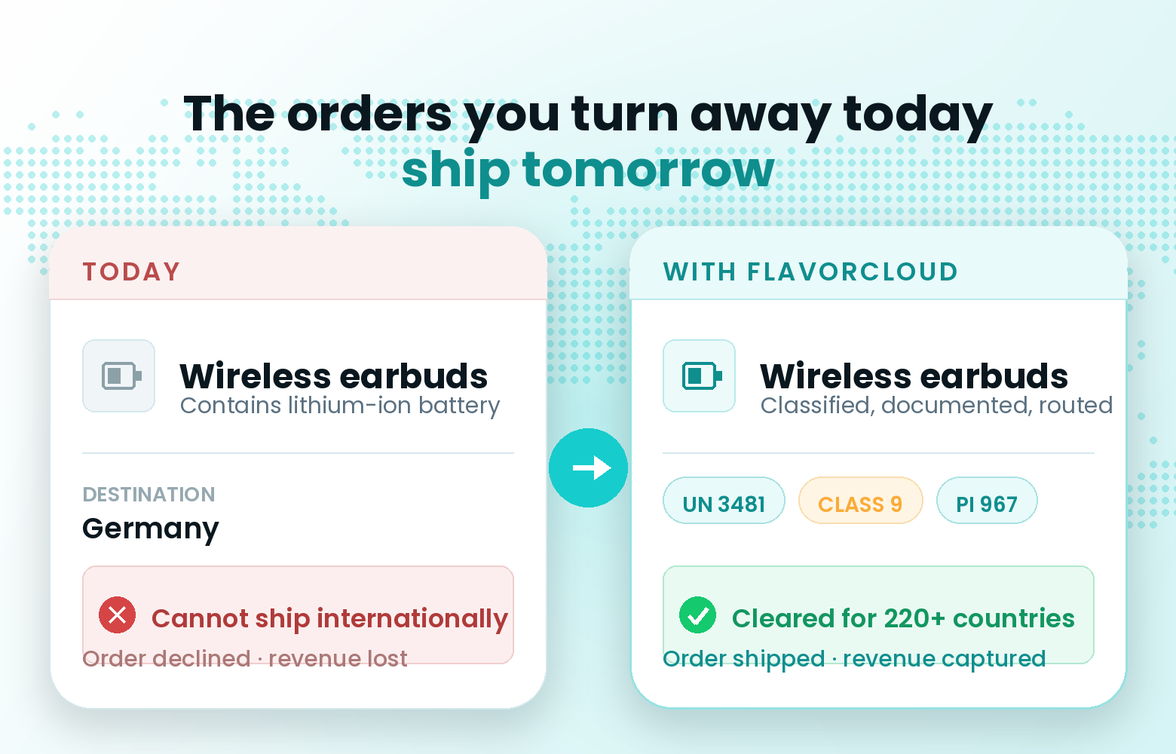
FlavorCloud’s Dangerous Goods solution recovers the international revenue you’re missing by not being able to ship DGs internationally
Choose a SKU, upload its classification details and the required supporting documents for the FlavorCloud team to review and approve.
After it sells, FlavorCloud routes it to the correct carrier and generates the labels and declarations each shipment needs. No per-carrier setup, no item-by-item review.
Your Dangerous Goods setup includes:
- Simple upload of specs and required documents
- Correct carrier routing per SKU
- Labels and declarations generated for you
- A repeatable setup you run with your FlavorCloud team, no per-carrier work
Request a demo and start shipping the dangerous goods products you block from orders today.
Questions
FAQs
A dangerous good is any item that poses a risk to health, safety, property, or the environment during transport. Common ecommerce examples include perfume, lithium batteries, aerosols, nail polish, and hand sanitizer.
Yes. Alcohol-based perfume and cologne are flammable liquids classified as UN1266, Class 3. They require compliant packaging and documentation, though consumer sizes often qualify for reduced limited-quantity requirements.
Yes, with strict conditions. Batteries must pass UN 38.3 testing, use compliant packaging and labels, and by air are generally held to a 30% state-of-charge limit. Standalone lithium-ion batteries are typically restricted to cargo aircraft.
Yes. In the US, anyone who classifies, packs, labels, or prepares dangerous-goods paperwork is a hazmat employee who must be trained, with refresher training at least every three years. Air shipments require IATA-equivalent training.
It is the formal document that certifies a shipment is correctly classified, packed, marked, and labeled for transport. It is required for fully regulated air shipments, and the signer is legally accountable for its accuracy.