Projected ecommerce market size in 2026 (USD), growing to $505B by 2031
Mordor Intelligence, 2026The Definitive Guide to Cross-Border

Commerce in the United Kingdom
For most US brands, the UK is the natural first international market: a large, mature, English-speaking market where the cross-border buying habit already exists and your brand needs no translation. This guide covers both halves of the opportunity: how to turn the UK on and grow it into a meaningful share of revenue, and how to get the compliance right, starting with the one number that governs every parcel you send, the £135 threshold, and the customs duty relief behind it, which the government is withdrawing in October 2028.
The UK opportunity
No other international market gives a US brand this combination: scale, maturity, a shared language, and a consumer base that already buys across borders as a matter of routine. The UK is where American brands can go live fastest, because most of the friction that slows entry elsewhere, translation, localized product content, unfamiliarity with US names, simply is not there. What is there is a hard compliance line at £135 and a Value Added Tax (VAT) regime that expects the seller to act. Get those right and the UK becomes the cleanest international lane you run.
UK adults shopping online
PromoCode, 2026Largest ecommerce market in the world, behind China and the US, and the largest in Europe
PromoCode, 2026The bigger picture. FlavorCloud's position: for most brands, international sits at 10 to 20% of revenue. For the brands winning globally, it reaches 40 to 60%, and it becomes their most defensible, compounding source of growth. The gap is about risk rather than demand: compliance exposure, pricing that does not travel, and supply chains built for a single market. The UK is where most US brands close that gap first, and this guide is how.
Mobile-first, and checkout is where it is won
Mobile carries around 55% of UK ecommerce transactions, and close to half of cross-border orders are placed on a phone. A checkout that is not clean on mobile is a checkout that leaks revenue. Charle, 2026 →
The largest, most mature market in Europe
The UK is the third-largest ecommerce market in the world and the largest in Europe, with roughly 46 million online shoppers and online sales running near 30% of total retail. Demand is deep and the infrastructure is built. PromoCode, 2026 →
The tax structure is predictable once you know it
One VAT rate to plan around (20%), a clear duty line at £135, and no per-country patchwork. The complexity is not the rules, it is that many sellers do not register for UK VAT, do not collect at the point of sale on low-value orders, and push the correction to the customer's door.
The cross-border habit is already there
Around 31% of UK online shoppers buy from overseas retailers, and nearly a third of them do so at least monthly. Fashion is the category they reach abroad for most. You are entering a market where buying from foreign brands is already an everyday habit. Whistl, 2026 →
Shared language, so no localization tax
The single biggest reason the UK is an easier first market than most: your storefront, product detail, support, and marketing already work. There is no translation layer and no rewrite of your catalog. US brands are familiar and trusted, and both the US and UK rank among the most trusted origins for global shoppers. DHL, 2025 →
The £135 duty relief is on the clock
Announced at the Autumn Budget 2025 and brought forward in June 2026, the £135 customs duty relief on low-value imports will be removed by October 2028 at the latest, with draft legislation published in July 2026. Brands that enter now and build clean customs data are the ones ready when every parcel becomes a formal import. GOV.UK, 2026 →
Where the growth is, by vertical
UK demand is not evenly distributed, and several of the strongest categories map directly onto what US brands already sell well. Fashion leads both domestic online spend and cross-border baskets, beauty and electronics follow, and home and premium consumables round out the mix. If your catalog sits in these categories, you are selling into the busiest part of a market that already knows how to buy from abroad.

Fashion & Apparel
Largest online category – 29% revenue shareFashion is the largest UK online category and the one shoppers most often buy cross-border. Sizing confidence, clear returns, and fast delivery matter most here. Note that adult clothing is standard-rated for VAT, while children's clothing and footwear are zero-rated.
Mordor Intelligence, 2026

Beauty & Personal Care
High digital share – 45% sold onlineOne of the most digitally native categories in the UK, with strong repeat behavior and heavy discovery on social. Cosmetics carry specific UK labeling and safety obligations, covered later in this guide.
Mordor Intelligence, 2026

Consumer Electronics
4th cross-border category – 14% of cross-border buysElectronics spike hard around Cyber Weekend, when tech buyers concentrate. Many electronics carry a 0% duty rate, and CE marking is now recognized in Great Britain indefinitely, which lowers the compliance lift for brands already selling in the EU.
Landmark Global / IPC Cross-border Shopper Survey, 2025

Home, Garden & Homeware
Steady online – 22.7% of salesA large and steady online category in the UK, weighted toward Boxing Day and January clearance. Higher-value home orders often clear the £135 line, so accurate duty and VAT at checkout matters more here than in low-ticket categories.
Office for National Statistics via Statista, 2025The cross-border tailwind. Roughly 31% of UK online shoppers already buy from overseas, and nearly a third of them do so at least monthly (Whistl, 2026). When asked why, they cite fast delivery, easy access to products, more choice, and better prices in roughly equal measure (Landmark Global, 2025). US brands are not opening a closed market. They are entering one where the habit, the trust, and the language are already in place.
The UK revenue playbook
Compliance and guaranteed Delivered Duty Paid (DDP) get you across the border. That is the foundation, the layer that de-risks international and makes it operational. Growth is the layer on top. FlavorCloud calls it Commerce Intelligence, using your own funnel data alongside our cross-border network data to find the opportunity, act on it, and compound it market by market. The plays below are that layer applied to the UK. They draw on what British shoppers actually do, when they spend, how they pay, and what they expect at the door.
UK demand concentrates into a handful of moments, most of them imported from the US retail calendar, which works in your favor. You do not need year-round intensity. You need to be in stock and live on these dates, with landed cost handled so nothing stalls at customs during peak.
Late Nov
Cyber Weekend (Black Friday to Cyber Monday)
The single biggest online window of the year. Over the four-day period in 2025, UK shoppers were forecast to spend £3.8B online, about 14.2% of all holiday revenue, with Black Friday at £1.19B and Cyber Monday at £963.6M. Cyber Monday consistently pulls the most orders.
Adobe Digital Insights, 2025Nov–Dec
Christmas run-up
The longest spending window of the year. UK online holiday spend (1 Nov to 31 Dec) hit a record £26.9B in 2025, up more than 4% year on year, with roughly 57% of it, £15.3B, on mobile.
Adobe Digital Insights, 2025Dec 26
Boxing Day & January sales
The UK's classic post-Christmas clearance, now launching online on Christmas evening. Boxing Day online spend was forecast to pass £500M for the first time in 2025. Demand stays high into the January sales.
Adobe Digital Insights, 2025Jul
Amazon Prime Day & summer sales
A mid-year demand spike that has trained UK shoppers to expect discount events outside the festive season. A useful window to test the market and clear inventory before autumn peak.
National Report, 2026Why UK shoppers buy cross-border
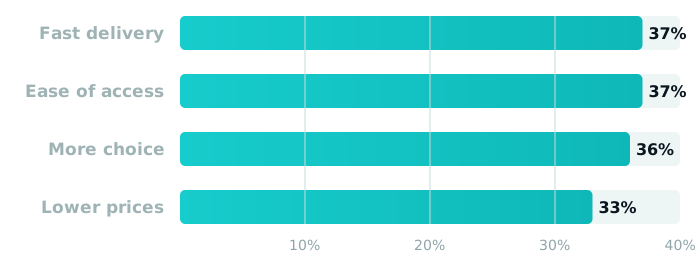
Fig. 1: Why UK shoppers buy cross-border (share citing each reason; respondents could select more than one). The four reasons sit within four points of each other, so read this as four roughly equal drivers rather than a ranking. Source: Landmark Global, 2025.
UK expectations are set by Amazon and a dense domestic carrier network, so the bar is high: the average British shopper expects delivery within two to three days, a clear returns policy is the single most important purchase consideration for most, and free or low-cost shipping is close behind. Delivery is the most common reason a UK basket is abandoned. Offer a choice of speeds, be transparent on cost, give tracking, and hit the date you promised.
- 2–3 days is the expected delivery window
- 57% rank a clear returns policy as most important
- 79% say free shipping increases purchase likelihood
- 40.6% have abandoned a purchase over delivery issues
- Top abandonment drivers: high shipping cost 78.5%, slow delivery 41.6%
- 1 in 3 UK online purchases is returned
Unexpected costs at checkout are the top reason UK shoppers abandon, and this is now a legal issue as well as a conversion one: the Digital Markets, Competition and Consumers Act 2024 is being enforced against hidden or drip pricing. Show a single all-in price with VAT (and, on orders over £135, duty) already calculated and collected. On low-value orders the seller is expected to charge UK VAT at the point of sale, so a vague estimate is not just poor experience, it is a compliance gap.
- 48% abandon when hit with unexpected costs at checkout
- ~75% mobile cart abandonment rate
Source: UK Web Works, 2026
A raw USD-to-GBP conversion shown at checkout reads as foreign, and a price that is actually charged in dollars can attract the shopper's own bank conversion fee on top. Quote and charge in pounds, and set deliberate GBP price points that land where British buyers expect them, rather than letting the exchange rate set your prices for you. It signals you belong in the market instead of passing through it.
English removes the hardest part of localization, but it does not remove all of it. UK shoppers notice US spelling, US sizing, and dollar prices. The low-effort, high-return moves are: UK spelling in copy, UK size conversions on apparel and footwear, prices in pounds, and trust signals a British buyer recognizes (a UK returns address, GBP at checkout, familiar payment logos). Small changes, and they read as built for the market rather than shipped into it.
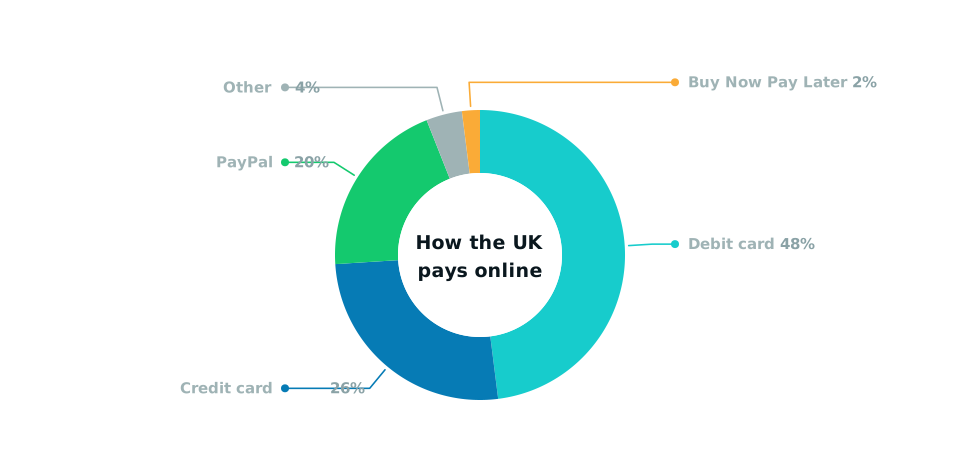
Cards dominate UK online checkout, led by debit, with PayPal a strong third and Buy Now Pay Later (BNPL) now used by around one in four adults, concentrated in fashion. Mobile-wallet adoption jumped from 42% to 57% of adults in a single year, so Apple Pay and Google Pay are table stakes on mobile. The merchants who convert offer a stack that matches how the country pays.
How the UK pays online (share of purchases)
Fig. 2: Share of UK online purchases by payment method. Buy Now Pay Later (BNPL) shows small here because this measures share of purchase volume, not adoption: around one in four UK adults has used BNPL, but it settles a low single-digit share of transactions. Mobile-wallet spend (Apple Pay, Google Pay) sits inside the card figures rather than alongside them. Source: Airwallex, 2025.
- Cards run ~74% of UK online transactions (debit plus credit)
- Mobile-wallet adoption: 42% → 57% of adults in a year
- BNPL adoption: ~1 in 4 adults have used it, fashion-led
- Leading BNPL: Klarna, Clearpay, PayPal Pay in 3
UK shoppers compare before they buy, and they judge the pound figure in front of them. A price that is simply yesterday's USD list run through a foreign exchange (FX) feed will swing with the rate and rarely lands on the price points British buyers respond to. Once the lane is running and you have enough UK order volume to read a signal, FlavorCloud Pricing Intelligence sets deliberate prices at the SKU level, localized so each price reads as native in pounds, and updates them as the inputs that drive margin move: tariffs, fuel surcharges, and seasonality around peaks like Cyber Weekend. It runs on autopilot and reports against the two numbers that decide whether a market is working, conversion and margin.

What separates brands that win in the UK
The UK does not stall brands because the market is hard. It stalls brands because they treat the £135 rule and UK VAT registration as something to sort out after the first problem. The merchants scaling here have made the right moves early: they know which side of £135 each order sits on, they register for UK VAT and collect at the point of sale on low-value orders, and they hold a GB EORI with clean commodity codes before shipment one. None of this is advanced. It is the baseline for operating in the UK with confidence.
FlavorCloud clears 99.7% of US→UK shipments with no customs delay. We calculate accurate landed cost and attach complete documentation at checkout, which is what keeps orders out of customs holds and off the customer's doorstep as a surprise bill. That is the line between a parcel that arrives on schedule and one that stalls at the border. FlavorCloud platform data, US→UK, 2026 YTD
The UK splits at £135. On consignments of £135 or less, you charge UK VAT at the point of sale and there is no customs duty. Above £135, import VAT and any duty are collected at the border. Either way, the customer should see one all-in price at checkout. Our Landed Cost Engine calculates VAT and any duty at the point of sale, and guaranteed DDP collects it up front, which removes the surprise. Orders clear faster and convert better because of it.
If you sell consignments of £135 or less directly to UK consumers, you must register for UK VAT and account for it at the point of sale, and the usual £90,000 registration threshold does not shield an overseas seller from this obligation. You also need a Great Britain Economic Operators Registration and Identification (GB EORI) number to act as importer of record; without it, customs declarations cannot be processed and shipments are held. These are one-time setups that prevent the most common and most expensive UK entry mistakes.
A wrong commodity code or a missing product mark does not generate a warning, it generates a held shipment. Confirm the UK commodity code for every SKU on the UK Trade Tariff, and confirm your product marking (CE is recognized in Great Britain, UKCA is the alternative) for any regulated category before your first shipment. The cost of getting this right up front is trivial next to a held or returned order.
Understanding the UK's Import Costs & Requirements
From the £135 threshold and Value Added Tax (VAT) to customs identifiers, product marking, and carrier surcharges, here is what merchants need to know to ship confidently into the United Kingdom.
US–UK trade: what it does and does not cover
Unlike selling into Mexico under USMCA, there is no comprehensive US–UK free trade agreement and no general duty preference for US consumer goods. The 2025 US–UK Economic Prosperity Deal is sector-specific, covering areas like autos, steel, aluminium, aerospace, beef, and ethanol, and it is weighted toward UK exports to the US rather than US goods entering the UK (Economics Observatory, 2025). For a US direct-to-consumer brand, the practical relief is the £135 duty threshold itself: parcels at or below it pay no customs duty today. Above £135, US-origin goods pay the UK's standard tariff by commodity code, and the £135 duty relief is due to end by October 2028.
Quick reference: key thresholds at a glance
Duty de minimis
Goods value, ex-shipping. Duty relief removed by Oct 2028VAT de minimis
All commercial imports owe VATStandard VAT
On most imported goodsUnder £135
Seller charges VAT at point of saleThe UK does not have tiered de minimis by origin. It has one line, £135, and which side of it a consignment sits on decides both who collects VAT and whether duty applies. The £135 figure is the intrinsic value of the goods, excluding transport and insurance, and it applies to the whole consignment, not to each item inside it.
| Consignment value | Customs duty | VAT | Who collects VAT |
|---|---|---|---|
| £135 or less | None | 20% (or 0% if zero-rated) | Seller, at point of sale |
| Over £135 | By commodity code | 20% import VAT | At the border (import) |
| Sold via online marketplace (≤£135) | None | 20% (or 0%) | Marketplace (deemed supplier) |
Value basis: the £135 test uses the goods value alone (excluding shipping and insurance). A £130 product with £10 shipping still counts as a £130 consignment for the threshold. Above £135, duty is calculated on the customs value, which does include freight and insurance to the UK. Reference: GOV.UK: VAT on overseas goods sold to UK customers.
Excise exception: consignments containing excise goods (alcohol, tobacco) do not qualify for the low-value treatment and are handled separately. See the Excise & Sugar Levy section.
The duty relief is ending in October 2028. At the Autumn Budget 2025 the government announced it would remove the £135 customs duty relief for low-value imports by March 2029 at the latest, then brought that forward by six months in June 2026, so the relief now ends by October 2028. A consultation ran from late 2025 to 6 March 2026; the summary of responses and draft legislation were both published on 13 July 2026. Two points worth holding onto: import VAT is unchanged, and only the duty position moves; and gift shipments remain outside these rules. Once the relief goes, every commercial consignment becomes a formal import regardless of value. Sources: GOV.UK, 2026; FlavorCloud.
Why it matters now: low-value imports into the UK reached £5.9B in the year to April 2025, up 53% year on year, which is precisely why the relief is being withdrawn. Building clean customs data today is what keeps you operational when it goes. Source: Forbes citing HMRC, 2025.
VAT is the tax that applies to almost everything you sell into the UK. The standard rate is 20% and has been since 2011. On consignments of £135 or less, you charge it at the point of sale; above £135, it is charged as import VAT at the border on the customs value (goods plus freight and insurance to the UK) plus any duty.
Standard rate
20%
Applies to most imported goods, including adult clothing, footwear, electronics, cosmetics, and homeware.
Zero rate
0%
Children's clothing and footwear, most food, and books, newspapers and magazines (print and digital). You still register and file, and can reclaim input VAT.
Landed cost example (over £135, illustrative): a £200 apparel order with £20 shipping has a customs value of £220. At an illustrative 12% apparel duty rate, duty = £26.40. Import VAT = 20% × (£220 + £26.40) = £49.28. Total landed cost = £295.68. Duty rates vary by commodity code, so confirm yours on the UK Trade Tariff.
Fig. 3: How landed cost builds on a £200 apparel import over the £135 line (illustrative). Import VAT applies to customs value plus duty. Under £135, there is no duty and VAT is collected by the seller at checkout. Method per UK Trade Tariff; figures from this guide.
Overseas sellers must register: for consignments of £135 or less sold directly to UK consumers, the £90,000 UK VAT registration threshold does not apply. You register and charge VAT from the first sale. Reference: GOV.UK.
On top of VAT and any customs duty, a few categories carry additional taxes. If your products fall into these, expect higher landed costs, and remember that low-value relief does not apply to excise goods.
- Alcohol (beer, wine, cider, spirits)Excise duty by strength
- Tobacco products (cigarettes minimum excise)£471.93 / 1,000
- Soft drinks, 5g–8g sugar per 100ml (SDIL standard)£1.94 / 10 litres
- Soft drinks, 8g+ sugar per 100ml (SDIL higher)£2.59 / 10 litres
- Soft drinks, under 5g sugar per 100mlExempt
The Soft Drinks Industry Levy is paid by the importer for drinks produced overseas, at the rates above since 1 April 2025. From January 2028 the levy is set to widen to milk-based drinks and the sugar threshold is due to drop. Sources: Finance Act 2025, s.79; Institute for Government, 2025. Tobacco minimum excise per Elemental CoSec citing HMRC, 2025.
The UK does not levy a percentage customs-processing fee the way some markets do. What it requires instead is correct paperwork and identifiers. Get these in place and clearance is routine; miss one and shipments are held.
| Requirement | What it is | Notes |
|---|---|---|
| GB EORI number | Importer identifier | Required to import into England, Wales, or Scotland |
| UK VAT registration | For ≤£135 sales | Charge VAT at point of sale; no £90k threshold relief |
| Commodity code | Per SKU | Sets duty rate; look up on the UK Trade Tariff |
| Customs declaration | Per import | Filed on the Customs Declaration Service (CDS) |
| Customs value | Transaction value | Goods plus freight and insurance to the UK, for duty above £135 |
| Licences / certificates | Category-specific | Some goods need permits before they clear (see resources) |
FlavorCloud acts as importer of record and files clearance on your behalf, so the GB EORI, CDS declaration, and customs valuation are handled as part of guaranteed DDP rather than left to you or your customer. Reference: GOV.UK: Import goods into the UK, step by step.
This is where the UK is markedly easier than most markets, and easier than it was a few years ago. For the majority of consumer goods, Great Britain now recognizes the CE mark indefinitely, so a US brand already selling into the EU can use the same conformity work for GB. The UKCA mark remains available as an alternative but is not mandatory for these categories.
Under the Product Safety and Metrology etc. (Amendment) Regulations 2024, in force since 1 October 2024, the UK removed the expiry on CE recognition across the great majority of consumer product regulations covering Great Britain, including toys, electronics, machinery, radio equipment, and personal protective equipment (PPE). A few categories are excluded and still need UKCA or UK-specific routes, and Northern Ireland follows separate rules.
-
Most consumer goods (GB)
CE mark recognized indefinitely; UKCA optional
-
Toys, electronics, machinery, PPE, radio equipment
Covered by indefinite CE recognition in Great Britain
-
Medical devices
UK-specific route under the MHRA; CE recognition still transitional
-
Construction products
Separate UK framework, with its own indefinite CE recognition; check current rules
-
Cosmetics
UK Cosmetics Regulation; Responsible Person, labeling, safety report
-
Textiles & footwear
Fibre composition and material labeling required
-
Food & supplements
FSA labeling, allergens, and composition rules
-
Northern Ireland
CE required under the Windsor Framework; UKCA alone is not valid there
The English-language advantage. Because your labeling and product content are already in English, the UK removes the translation and re-labeling step that markets like Mexico require. Confirm marking for regulated categories, then ship. Sources: GOV.UK; Landmark Global, 2026.
Carrier surcharges are dynamic, carrier-specific, and subject to change without notice. Items marked "all shipments" apply broadly; the rest are assessed on an ad hoc basis depending on shipment characteristics. Figures below are indicative and in GBP unless noted.
Standard (all shipments)
| Fuel surcharge (express) | Dynamic % of transport |
| Peak season (Nov–Dec) | Per-parcel, carrier-set |
| Emissions / handling | Variable |
Dangerous goods
| Fully regulated (IATA DGR) | Per shipment |
| Consumer goods (IATA ID8000) | Per shipment |
| Perfumes, aerosols, nail varnish | ID8000 applies |
Ad hoc basis
| Saturday delivery / pickup | Variable | Remote area delivery / pickup | Variable |
| Residential delivery | Variable | Declared value / insurance | Variable |
| Oversize / overweight piece | Variable | Address correction | Variable |
Not registering for UK VAT before selling under £135
On consignments of £135 or less sold directly to UK consumers, the seller must charge UK VAT at the point of sale and be registered with HMRC. Skipping this is the most common overseas-seller error, and the £90,000 threshold does not exempt you.
Assuming the US–UK deal gives duty-free access
The Economic Prosperity Deal does not create a general duty preference for US consumer goods into the UK. Above £135, your goods pay the standard UK tariff by commodity code. Plan landed cost accordingly.
Splitting or undervaluing orders to stay under £135
Splitting consignments or understating value to duck the threshold draws scrutiny from His Majesty’s Revenue and Customs (HMRC), and the duty relief is being withdrawn in October 2028 anyway. Build for a world where value-based relief no longer applies.
Shipping without a GB EORI or with the wrong commodity code
No GB EORI means declarations cannot be processed and parcels are held. A wrong commodity code means the wrong duty and possible reassessment. Confirm both before shipment one.
Hiding costs until the final checkout step
Unexpected costs are the top UK abandonment driver, and drip pricing is now enforced under the Digital Markets, Competition and Consumers Act 2024. Show one all-in price with VAT and any duty included.
Discover the Revenue Waiting for You in the United Kingdom
FlavorCloud is the AI Native Commerce Intelligence Platform. Our Cross-Border Commerce OS calculates the UK's full landed cost (VAT and any duty) at checkout and delivers with guaranteed DDP, handling UK VAT, the GB EORI, and CDS clearance, which clears the friction this playbook runs on: accurate prices in pounds, no surprise bills, faster clearance, higher conversion. Then Commerce Intelligence turns the UK from a first step into one of your most profitable, compounding revenue channels. International is an asset, and we will help you build it.
Official resources
-
Import goods into the UK: step by step
gov.uk/import-goods-into-uk
↗️ -
VAT on overseas goods sold to UK customers (£135 rule)
gov.uk (HMRC)
↗️ -
UK Trade Tariff: commodity codes & duty rates
gov.uk/trade-tariff
↗️ -
Get an EORI number
gov.uk/eori
↗️ -
VAT rates on goods and services
gov.uk/vat-rates
↗️ -
Placing UKCA or CE marked products on the GB market
gov.uk (DBT)
↗️
Import tax rates, thresholds, and admissibility requirements are dynamic and may change without notice. Always verify current rates with official sources before shipping. FlavorCloud recommends confirming requirements with HMRC and a commodity-specific expert before your first shipment.