$340.2B
US retail ecommerce sales in Q2 2026 alone, seasonally adjusted
US Census Bureau, Q2 2026
US online growth is not evenly distributed, and for a brand importing into the US, headline category growth is only half the question. The other half is what the category costs to land. Two categories carry most of the regulatory weight, and two are decided almost entirely by product and price.

Home goods, gifts and lifestyle products are a natural fit for imported brands that sell on design and story rather than price. For an imported brand, the variable to watch is classification: home and lifestyle goods span dozens of tariff headings with very different MFN rates, so the same catalog can land at very different costs SKU by SKU.
Harmonized Tariff Schedule of the United States, USITC
Clothing and accessories is one of the largest online categories in the US. It is also crowded, discount-led and returns-heavy, and apparel carries some of the highest MFN duty rates in the US tariff schedule before any Section 301 duty is added. Brands win here on distinctiveness and fit confidence, not price, and need landed cost modelled per SKU before launch.
Harmonized Tariff Schedule of the United States, USITC
Imported beauty brands sell into the US on the strength of formulation and brand, and replenishment does the retention work. The gate is regulatory. Cosmetics are overseen by the Food and Drug Administration (FDA), and a product claim that implies treating a condition can move it into drug territory. FDA-regulated goods are also being excluded from the postal entry process, with compliance required from 20 January 2027, which pushes beauty brands that relied on the post onto a parcel or formal entry route.
CBP, CSMS #69183472, July 2026
Supplements, specialty foods and beverages have strong US demand and the heaviest import requirements. Food shipments generally require FDA prior notice before arrival, and alcohol is excluded from the postal process entirely. These categories travel well only when admissibility is cleared before shipment one, which is why they reward a parcel network with compliance built in rather than an ad hoc postal route.
CBP, CSMS #69183472, July 2026Check the calendar effect before reading the growth rates. Amazon moved Prime Day to 23 to 26 June in 2026, earlier than its usual July slot, which likely pulled some online spending from the third quarter into the second. Treat Q2 2026 growth as directional, and compare against the Q3 release before setting targets (Amazon, 2026).
Compliance and guaranteed Delivered Duty Paid (DDP) get you across the border. That is the foundation, the layer that de-risks international and makes it operational. Growth is the layer on top. FlavorCloud calls it Commerce Intelligence, using your own funnel data alongside our cross-border network data to find the opportunity, act on it, and compound it market by market. The plays below are that layer applied to the United States.
The US calendar is the one most other markets copied, and it is more concentrated than most brands expect. Four windows carry the year, and the import lead time sits in front of each one: a parcel that clears in a day still needs stock positioned and landed costs confirmed before the discount goes live.
The US shopping calendar: four windows carry the year
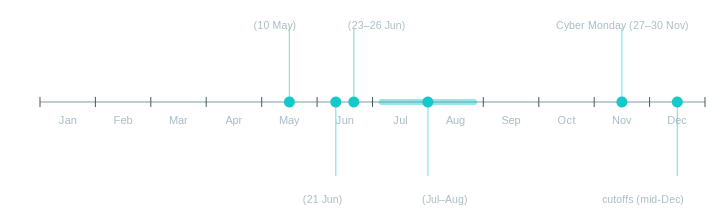
Fig. 1: The US anchor sale windows across the trading year. Prime Day moved to 23 to 26 June in 2026, earlier than its usual July slot. Thanksgiving falls on 26 November 2026, putting Black Friday on 27 November and Cyber Monday on 30 November. Import lead time sits in front of every window, so confirm landed costs at the rate in force on arrival. Source: Amazon, 2026 (Prime Day).
May–Jun
Mother's Day falls on 10 May in 2026 and Father's Day on 21 June. Both are gifting peaks where delivery certainty matters more than price, so publish a last order date and hold to it.
Jun–Jul
Amazon moved Prime Day to 23 to 26 June in 2026, and other retailers run their own events around it. Even brands that do not sell on Amazon see shoppers deferring purchases into the window.
Amazon, 2026Jul–Aug
Apparel, footwear, bags and stationery see a second summer peak as families prepare for the school year. For apparel brands this is often worth as much as early holiday.
Nov 27–30
Thanksgiving falls on 26 November in 2026, which puts Black Friday on 27 November and Cyber Monday on 30 November. Holiday shipping cutoffs follow in mid-December. Import lead time is the constraint here, not demand.
Tariff changes in 2026 took effect on 24 February, 24 July, 22 August and 15 September. None of them waited for a promotion to end. Confirm your landed costs against the rates in force on the expected arrival date, not the order date, before you lock a peak price.
Every order into the US now owes duty, and the amount depends on the product's classification and its country of origin. A shopper who is asked to pay that at the door, plus a carrier's brokerage fee, often refuses the parcel. The fix is to calculate the full landed cost at checkout and ship DDP, so the price on the product page is the price the customer pays. It also removes the single most common cause of refused deliveries and the returns cost that follows them.
Source: FlavorCloud platform data, non-US origin to US, 2026 YTD; CBP, Federal Register, June 2026
US shoppers expect round, native price points in USD, not a converted figure that changes with the exchange rate. The harder problem in 2026 is that the duty itself moves: an apparel SKU from the UK, Australia and the EU now carries three different Section 301 rates on top of the same MFN duty. FlavorCloud Pricing Intelligence sets deliberate prices at the SKU level and updates them as the inputs that drive margin move: tariffs, fuel surcharges, exchange rates and seasonality around Prime Day and Black Friday–Cyber Monday. It reports against the two numbers that decide whether a market is working, conversion and margin.
There is no national sales tax, but most US states require remote sellers to collect sales tax once their sales into that state pass an economic nexus threshold, commonly USD $100,000 a year. The obligation is state by state, the rates vary down to the local level, and it is separate from import duty. Brands growing fast in a handful of states can cross several thresholds in one peak season. Track sales by destination state from the first order, and decide early whether marketplace sales, where the marketplace usually collects, will run alongside your own storefront.
National category growth tells you where demand is moving. It does not tell you which of your own products convert once duty is in the price. FlavorCloud Market Intelligence shows conversion and margin by category and by state for your own US traffic, so you can see which products are worth a US-specific price point, which need a different origin or fulfilment route, and which are better left out of the US catalog until the tariff picture settles.
Until August 2025, goods worth USD $800 or less could enter the US free of duty and with minimal paperwork. That exemption is now suspended for every country, every value and every mode of transport, and the One Big Beautiful Bill Act repeals it in statute from 1 July 2027. The change came in stages, and the postal route was the last to close.
| Date | What changed | Who it affects |
|---|---|---|
| 29 Aug 2025 | De minimis suspended for all non-postal shipments | Courier, express and parcel networks |
| 24 Feb 2026 | IEEPA tariffs end after the Supreme Court ruling; 10% Section 122 surcharge applies | All shipments, including postal |
| 24 Jul 2026 | Section 122 expires; Section 301 forced-labor tariff begins; new postal entry process with broker and bond | All shipments; postal now pays full MFN and Section 301 duty |
| 20 Jan 2027 | FDA and other agency-regulated goods, Chapter 98/99 goods and FTA claims excluded from postal entry (postponed from 22 Oct 2026) | Postal shipments of regulated goods |
| 1 Jul 2027 | De minimis repealed in statute | Everyone, permanently |
The flat postal fee is gone. The USD $80, $160 and $200 per-parcel postal duties that applied after August 2025 were a transitional option and no longer apply. Postal shipments paid a flat 10% from February to July 2026, and since 24 July they pay the same MFN, Section 301 and Section 232 duties as commercial shipments (CBP, Federal Register, June 2026; Executive Order 14324, Federal Register, August 2025).
Gift and traveller exemptions are different rules. The suspension does not change the separate bona fide gift exemption or the traveller personal-article exemption. A commercial sale to a consumer is not a gift, and labelling it as one to avoid duty creates exposure for the shipper.
US duty on a consumer order is now built from layers. The base is the Most Favored Nation (MFN) rate set by the product's 10-digit HTS classification. On top sits the Section 301 forced-labor tariff, which took effect on 24 July 2026 at a rate set by the country of origin. Some goods carry further layers: Section 232 for steel, aluminum and certain other products (which are exempt from the forced-labor tariff), Section 338 for listed Canadian-made goods, and the long-standing Section 301 lists for goods made in China. Duty is assessed on the transaction value of the goods, excluding international freight and insurance.
| Country of origin | Section 301 forced-labor rate | Notes |
|---|---|---|
| United Kingdom | 10% | Added on top of MFN |
| Canada | 10% | USMCA-qualifying goods exempt on commercial entry; listed goods also owe 50% Section 338 |
| Mexico | 10% | USMCA-qualifying goods exempt on commercial entry |
| European Union | Capped: MFN + 301 = 10% | 0% extra where MFN is already 10% or more |
| Japan, South Korea, Switzerland | Capped: MFN + 301 = 12.5% | 0% extra where MFN is already 12.5% or more |
| Australia, New Zealand | 12.5% | Added on top of MFN |
| China, Vietnam | 12.5% | China also remains subject to earlier Section 301 lists |
Sources: USTR final action, 23 July 2026; USTR, Federal Register notice of action, 28 July 2026. Rates apply to 60 economies; check the USTR notice for any origin not listed here.
Same product, four origins: a USD $120 order. Take an item worth $120 with an illustrative 5% MFN rate, shipped DDP on a commercial informal entry. Made in the UK: $6.00 MFN + $12.00 Section 301 + $2.77 MPF = $20.77. Made in the EU: $6.00 MFN + $6.00 Section 301 (capped at 10% combined) + $2.77 = $14.77. Made in Australia: $6.00 + $15.00 + $2.77 = $23.77. Made in Canada and qualifying for USMCA, not on the Section 338 list: no MFN, no Section 301, $2.77. Freight and any carrier brokerage fee are added on top, and state sales tax applies where you have nexus.
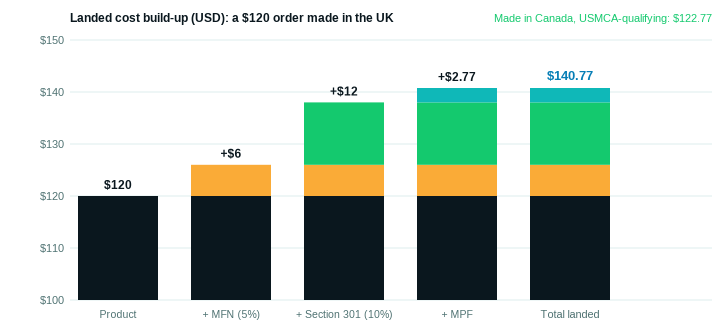
Fig. 2: A $120 order made in the UK, shipped DDP on a commercial informal entry, using an illustrative 5% MFN rate. The 10% Section 301 duty is stacked on top of MFN, and the $2.77 Merchandise Processing Fee applies per entry. Duty and fees add $20.77, or 17.3% of the goods value, before freight and any state sales tax. The same order made in Canada and qualifying for USMCA pays only the fee. Y-axis starts at $100 so the layers are visible. Sources: USTR, Federal Register, 28 July 2026; CBP, Federal Register, 31 July 2026.
MFN duty Section 301 Merchandise Processing Fee
Fig. 3: The same $120 order, four origins. Country of origin, not the country you ship from, sets the Section 301 rate: 12.5% for Australia, 10% for the UK, and for the EU a cap that holds MFN plus Section 301 to 10% combined. USMCA-qualifying Canadian goods not on the Section 338 list pay neither MFN nor Section 301. Illustrative 5% MFN rate. Sources: USTR, Federal Register, 28 July 2026; CBP, Federal Register, 31 July 2026.
Section 338 is a Canada-specific exception. Since 22 August 2026, a 50% duty applies to hundreds of listed Canadian-made goods, including categories such as furniture, paper, textiles, cosmetics and sporting goods, regardless of USMCA qualification. The scope changed again on 15 September 2026, adding 122 classifications. Canadian brands should check every SKU against the current list rather than assuming a category is in or out. See our Section 338 Commerce Intelligence Alert.
From August 2025 to July 2026, postal shipments into the US cleared through an interim process in which foreign postal operators and other qualified parties paid a simplified duty without a full classification. That process has been replaced. Under CBP's interim final rule, low-value mail shipments now move through a postal informal entry that asks the shipper side for most of what a commercial entry requires.
Goods sent by international mail, valued at USD $2,500 or less, classified in HTS Chapters 1–97, and otherwise eligible for informal entry.
Goods over $2,500, quota and antidumping goods, alcohol and tobacco, and, from 20 January 2027, goods regulated by partner agencies such as the FDA, Chapter 98/99 goods and FTA duty-free claims. These use formal entry or the new electronic Entry Type 13.
Foreign postal operators can no longer file for you. Only the owner or purchaser of the goods, or a licensed US customs broker they designate, can file a postal entry. The filer must hold a customs bond on file in ACE before the first filing, submit a monthly International Mail Duty Worksheet with the 10-digit classification, origin and value of every parcel by the 7th of the following month, and pay the duty through Pay.gov (CBP, CSMS #69183472, July 2026).
| Aspect | Postal (now) | Parcel network with DDP |
|---|---|---|
| Duty | Full MFN + Section 301; no flat-rate option | Full MFN + Section 301, calculated and collected at checkout |
| Who files | Owner, purchaser or a licensed broker you appoint | Handled within the shipment |
| Bond | Required before first filing | Carried by the network |
| FTA claims (e.g. USMCA) | Excluded from 20 Jan 2027 | Supported on commercial entry |
| Regulated goods | Excluded from 20 Jan 2027 | Entered with the required agency data |
| Tracking | Varies by post | End-to-end, integrated |
When de minimis was first suspended in August 2025, the Universal Postal Union reported that 88 postal operators had suspended some or all US-bound service, and postal traffic into the US fell by more than 80%. Many have since resumed with duty-paid postal services, but the July 2026 broker requirement added a new set of steps. Confirm your post's current US service before relying on it (Universal Postal Union, September 2025).
The US has no VAT or GST at the border. Instead, 45 states and the District of Columbia levy a sales tax, often with additional local rates on top. Since the Supreme Court's 2018 South Dakota v. Wayfair decision, states can require remote sellers with no physical presence to collect sales tax once their sales into the state pass an economic nexus threshold, which in most states is USD $100,000 of sales a year. Being based outside the US does not exempt a seller from these rules.
Duty and sales tax are separate obligations. Paying US import duty through a DDP checkout does not discharge state sales tax, and registering for sales tax does not reduce duty. Model both. Sales tax is calculated on the price to the customer and, in many states, on shipping charges as well.
Marketplaces change who collects. Every state with a sales tax has marketplace facilitator rules, under which the marketplace generally collects and remits on sales made through it. If you sell through both a marketplace and your own storefront, track the two separately, because your own nexus is usually measured on your direct sales.
Every entry into the US carries a Merchandise Processing Fee (MPF) collected by US Customs and Border Protection (CBP). The amount depends on whether the shipment is entered informally (USD $2,500 or less) or formally. The fees are adjusted each fiscal year, and the figures below apply from 1 October 2026.
| Entry type | Merchandise Processing Fee | Notes |
|---|---|---|
| Informal entry, automated (≤ $2,500) | $2.77 per entry | Was $2.69 in FY2026 |
| Formal entry (> $2,500) | 0.3464% of value | Minimum $34.58, maximum $670.86; bond required |
| Ocean freight only | Harbor Maintenance Fee, 0.125% | Not applicable to air parcels |
Source: CBP, Federal Register, 31 July 2026.
Carriers also charge their own brokerage or disbursement fees for clearing a shipment and advancing duty on your behalf. On a DDU shipment these land on the customer at the door, which is one of the main reasons US shoppers refuse parcels. A DDP quote includes them up front.
Paying the duty does not make a product admissible. Several federal agencies regulate specific goods at the border, and their requirements apply regardless of value. From 20 January 2027, goods regulated by these agencies also cannot use the postal entry process. CBP postponed this date from 22 October 2026 (CBP, Federal Register, October 2026).
Forced labor enforcement is separate from the forced-labor tariff. CBP can detain goods it believes were made with forced labor under withhold release orders, regardless of the tariff paid. Know your upstream supply chain, particularly for cotton, apparel and goods with components sourced from regions under US enforcement focus.
Carrier surcharges are dynamic, carrier-specific, and subject to change without notice. Items marked as all shipments apply universally; all others are assessed on an ad hoc basis depending on shipment characteristics.
| Fuel surcharge (express) | Dynamic % of transport |
| Peak season | Carrier-specific |
| Fully regulated (IATA DGR) | Per shipment |
| Consumer goods (IATA ID8000) | Per shipment |
| Perfumes, aerosols, nail varnish | ID8000 applies |
| Residential delivery | Variable |
| Remote / extended area | Variable |
| Address correction | Variable |
| Declared value / insurance | Variable |
| Oversize / overweight piece | Variable |
There is no de minimis for any country or any mode. Every order owes duty based on its classification and origin, and the statutory repeal from July 2027 makes this permanent.
Since 24 July 2026, postal parcels need a broker or purchaser to file, a bond, a 10-digit classification and monthly duty payment. From 20 January 2027, regulated goods cannot use the postal process at all.
Tariffs follow where goods were made. Shipping from Canada, the UK or the EU does not give a product made elsewhere that country's rate, and a wrong declaration is a compliance problem, not a saving.
USMCA removes the Section 301 forced-labor tariff for qualifying goods on commercial entry. It does not remove the 50% Section 338 duty on listed Canadian-made goods, and from 20 January 2027 it cannot be claimed through the postal entry process.
US tariff rates changed on four separate dates in 2026. A landed cost set at launch is very likely wrong now. Recalculate at the point of sale, on the rate in force at arrival.
Import duty and state sales tax are separate. Once direct sales into a state pass its economic nexus threshold, collecting sales tax is your obligation, wherever your business is based.
The gift exemption is for genuine gifts between individuals. Applying it to a sale to deliver duty-free creates exposure for the shipper and risks the parcel being held.
A DDU parcel arrives with duty and a carrier brokerage fee for the customer to pay. Many refuse it. A duty-inclusive price at checkout prevents the refusal, the return freight and the lost customer, and it is also the price an AI shopping agent can compare.