

Understanding Legal vs. Illegal Transshipment


September 5, 2025
Summary
Transshipment, the movement of goods through an intermediate country, has become a frontline compliance issue. Legal transshipment requires strict customs control and documentation, while illegal transshipment (disguising true origin) can lead to steep penalties, loss of preferential tariff treatment, and now, under new U.S. rules, additional tariffs of up to 40%. Companies must document origins carefully, understand evolving trade agreement rules, and use tools like Foreign Trade Zones (FTZs) to stay compliant. What was legal last year may no longer qualify today.
Why does transshipment matter now?
Transshipment is one of those logistics terms that seems straightforward: moving goods from one vessel to another during their journey. But in the context of global trade and compliance, it’s much more than that. Transshipment can determine whether your goods qualify for preferential tariff treatment, whether your supply chain is compliant, and, in some cases, whether your shipments are exposed to severe penalties and higher duties.
With new U.S. tariff penalties on illegally transshipped goods that went into place in August, understanding transshipment (and how tools like Foreign Trade Zones (FTZs) can help) has never been more critical. Stay up to date on the latest trade and tariff news on the FlavorCloud hub.
What is transshipment?
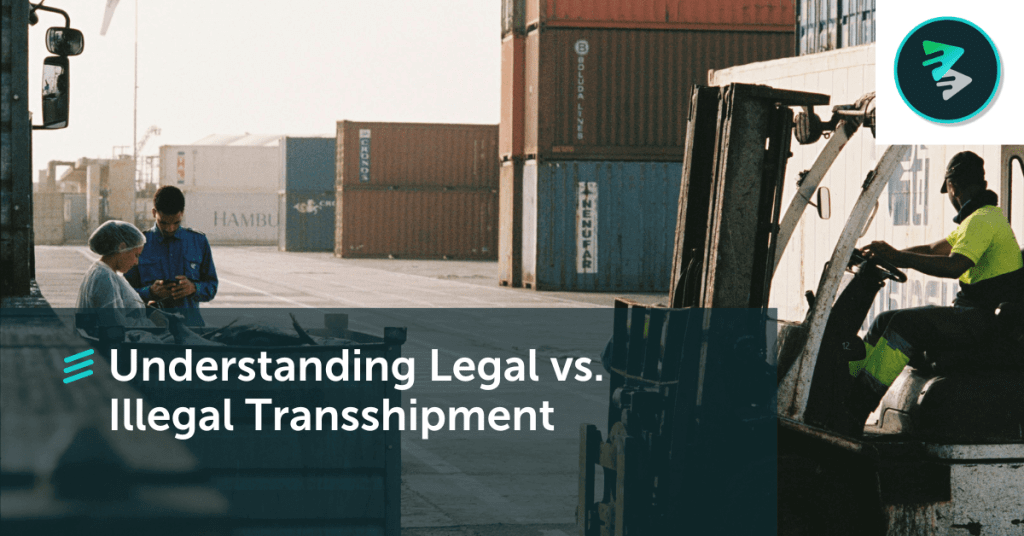
At its simplest, transshipment refers to the transfer of goods through an intermediate point before reaching their final destination. For example, cargo with products made in China may arrive at a port in Vietnam before continuing on to the United States.
In logistics, this can be a perfectly legitimate practice, especially when routes, carrier availability, or infrastructure require intermediate handling. However, under customs law, the difference between legal and illegal transshipment can determine whether your goods move smoothly or face steep duties and penalties.
- Legal transshipment: Goods remain under customs control in an intermediate country, undergoing only necessary operations such as unloading, reloading, or preservation. Documentation such as bills of lading and proof of final destination ensure compliance.
- Illegal transshipment: Goods are routed through a third country to disguise their true origin, often with little or no transformation that would alter the country of origin, and declared as originating from the transshipment country. This misrepresentation, often used to evade tariffs, can result in fines, penalties, or criminal liability.
What does the law say about compliance implications?
U.S. Customs and Border Protection (CBP) sets strict conditions for maintaining preferential tariff treatment under agreements like NAFTA (and now USMCA). Goods lose their originating status if they leave the free trade region and undergo operations beyond what’s necessary for transport or preservation.
For example:
- Surgical instruments made in the U.S. and cotton gowns made in Mexico lost NAFTA eligibility when they were packaged and sterilized in the Dominican Republic. The added processing was beyond “preservation” or “transport,” and thus disqualified the goods from preferential treatment.
Recent trade policy makes this even more pressing: Under an Executive Orders on tariffs, imports of goods deemed “transshipped” could face an additional 40% tariff, a provision echoed in other U.S. edicts connected with trade and tariffs, ostensibly to prevent Chinese goods from dodging tariffs by routing through Vietnam.
The takeaway: companies must document and prove that transshipped goods comply with customs rules or risk losing preferential duty treatment and facing significant financial exposure.
Navigating the evolving trade landscape
The ambiguity around what constitutes “transshipment” is only growing, as recent agreements suggest broader interpretations that capture not just rerouted goods but also those heavily dependent on third-country components. This shift puts multinational supply chains under greater scrutiny.
For businesses, the message is clear:
- Document everything. From bills of lading to origin certificates.
- Understand rules of origin under trade agreements like USMCA.
- Use FTZs strategically to control operations, minimize risk, and defer tariff costs.
- Stay vigilant as definitions evolve. What was legal last year may no longer qualify.
Compliance is strategy
Transshipment is no longer a background logistics concept, instead it’s a frontline compliance challenge. With new tariffs, aggressive enforcement, and expanded definitions of transshipment risk, companies must rethink how and where they move their goods. If you want to discuss transhipments in more depth or ensure you are compliant, book a meeting with one of our experts.


Grow your
Revenue
Revenue
With international sales on the rise, the opportunities have no borders. With FlavorCloud, you can tap new markets risk-free by offering global guaranteed delivery promises. Go global today.